





Every four years, the world comes together for the biggest sporting event on the planet: the FIFA World Cup. Countries battle it out for glory, fans lose their voices screaming at TVs, and someone inevitably cries over penalty kicks.
But while the players are out there representing their nations, it got me wondering: if every country sent its most iconic dog breed instead, who would make the ultimate canine dream team?
Spoiler: it would be chaos. Adorable chaos, but chaos.
So, in honor of the World Cup, let’s meet some of the top dog breeds from countries competing this year, and see how they’d stack up if paws replaced cleats.
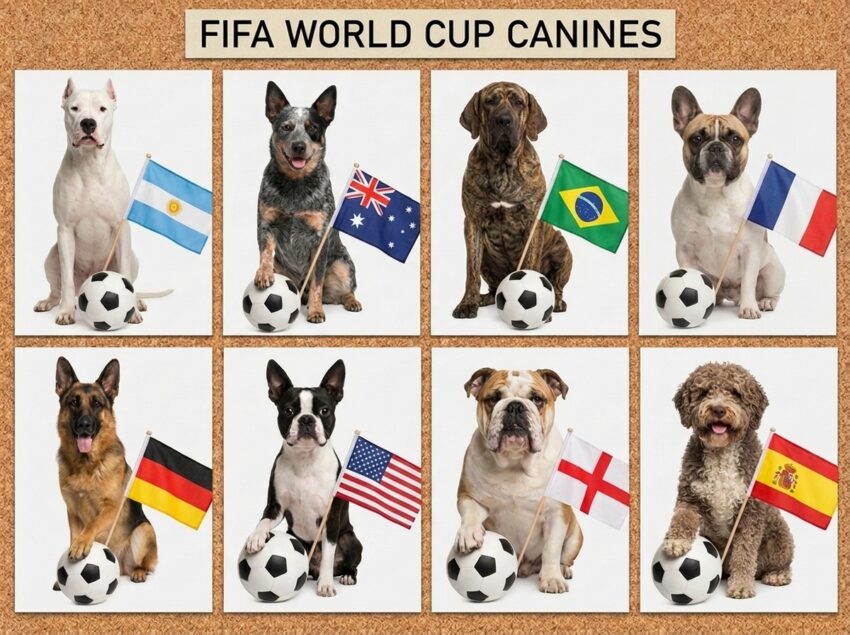
Argentina: Dogo Argentino
Strong, athletic, and impossible to ignore, the Dogo Argentino feels like the striker who barrels through defenders without blinking. Originally bred for big-game hunting, this dog is fearless, powerful, and surprisingly affectionate with family.
Basically? Argentina sent muscle.
World Cup role: Center forward
Energy level: “I can do this all day.”
Australia: Australian Cattle Dog
If there were an MVP for endurance, Australia would probably win it with the Australian Cattle Dog. Smart, relentless, and built for long days of hard work, this breed is the definition of hustle.
They’re basically the midfielders who never stop running.
World Cup role: Box-to-box midfielder
Special skill: Outworking everyone.
Belgium: Belgian Malinois
Belgium came prepared. The Belgian Malinois is fast, sharp, and intensely focused. It’s one of the top working dogs in the world, used in military and police work for a reason.
This is the tactical genius of the dog world.
World Cup role: Defensive anchor
Warning: Will absolutely judge your effort.
Brazil: Fila Brasileiro
Brazil’s canine representative is every bit as intense as its soccer reputation. The Fila Brasileiro is loyal, protective, and known for its bold personality.
Not exactly the flashy dribbler, more like the enforcer.
World Cup role: Center back
Playstyle: “You shall not pass.”
Canada: Labrador Retriever
Canada’s bringing the Labrador Retriever, arguably one of the friendliest dogs on Earth. Labs are athletic, versatile, and everyone loves them, which honestly feels very on-brand.
Would they dominate? Maybe not. Would they win the sportsmanship award? Absolutely.
World Cup role: Team captain
Biggest strength: Morale.
Croatia: Dalmatian
Croatia gets style points with the Dalmatian. Elegant, fast, and instantly recognizable, this breed is basically the flashy winger of the tournament.
Also, imagine trying to keep track of one during a fast break.
World Cup role: Wing attacker
Bonus: Already dressed for the occasion.
Germany: German Shepherd
Disciplined. Intelligent. Strong. Germany’s German Shepherd is basically the coach’s favorite player. Reliable, adaptable, and always locked in.
If there’s a game plan, this dog is following it.
World Cup role: Sweeper
Vibe: Tactical perfection.
Japan: Shiba Inu
Small but mighty, the Shiba Inu would absolutely be underestimated right up until it stole the ball and scored. Agile, clever, and independent, it’s the scrappy underdog everyone roots for.
Unless it decides not to participate. Classic Shiba.
World Cup role: Sneaky striker
Potential problem: Selective listening.
Mexico: Xoloitzcuintli
Ancient, elegant, and deeply tied to Mexican history, the Xoloitzcuintli might be one of the coolest dogs in the tournament. This breed goes back thousands of years and was considered sacred by the Aztecs.
Honestly, it’s bringing legacy energy.
World Cup role: Veteran playmaker
Cool factor: Off the charts.
Netherlands: Dutch Shepherd
Versatile and hardworking, the Dutch Shepherd is one of those dogs that can do just about anything. Fast enough for offense, tough enough for defense.
A total utility player.
World Cup role: Anywhere you need them
Strength: Adaptability.
United States: Boston Terrier
The U.S. could have gone with dozens of breeds, but the Boston Terrier feels right: energetic, scrappy, and way tougher than it looks.
Not the biggest player on the field, but definitely the one picking fights.
World Cup role: Aggressive midfielder
Secret weapon: Pure stubbornness.
England: English Bulldog
Was this the most athletic choice? Absolutely not. But iconic? Very.
The English Bulldog represents grit, determination, and looking exhausted while doing almost nothing. Honestly, that’s relatable.
World Cup role: Mascot
Cardio level: Limited.
France: French Bulldog
France has a whole bench full of great breeds, including the Poodle, Briard, Dogue de Bordeaux, Beauceron, Brittany, and Pyrenean Mountain Dog. But for this fun version, I’d go with the French Bulldog because it’s instantly recognizable and gives you the most personality to work with.
The Frenchie may not be built for 90 minutes of sprinting, but it has star power, confidence, and a face that says, “I meant to do that,” even when it absolutely did not.
World Cup role: Celebrity mascot
Biggest strength: Winning over the crowd without breaking a sweat.
Portugal: Portuguese Water Dog
Portugal brings serious talent with the Portuguese Water Dog. Athletic, smart, and famously energetic, this breed was originally used by fishermen to help with tasks like retrieving gear and carrying messages between boats.
Basically, this is the player who can run, think, swim, problem-solve, and still have enough energy left to chase a ball around the hotel room after the game.
World Cup role: Versatile midfielder
Biggest strength: Endless stamina and “put me in, coach” energy.
Spain: Spanish Water Dog
Spain has plenty of options, including the Galgo Español, Spanish Mastiff, Presa Canario, Ibizan Hound, and Bichon Frise from the Canary Islands. But the Spanish Water Dog feels like the best all-around pick.
This breed is smart, athletic, hardworking, and curly enough to look like it just stepped out of a very expensive salon. It’s a herder, helper, athlete, and low-key overachiever.
World Cup role: Playmaker
Biggest strength: Doing five jobs while making it look effortless.
So…Who Wins?
If we’re going by athleticism alone, Belgium’s Malinois probably takes the trophy. If we’re voting on popularity, Canada’s Lab has it locked up. If style matters, Croatia’s Dalmatian is impossible to beat.
And if chaos counts as a strategy? Australia’s Cattle Dog and Japan’s Shiba Inu are definitely making the finals.
Good thing the real World Cup is played by humans, because trying to referee this dog tournament would be impossible.
Although, let’s be honest, I’d watch every second of it.