





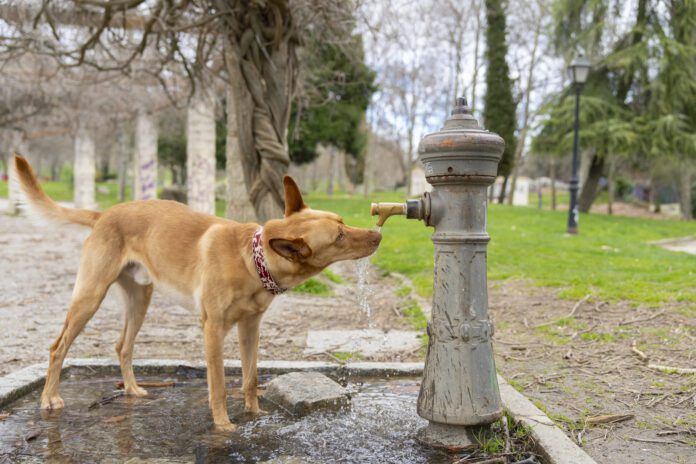
Your dog’s water bowl is empty—again. As you refill the bowl with water, your thoughts drift to how many times a day you have been finding his water bowl empty. He also seems to be urinating more.
It is normal for dogs to vary how much they drink according to their activity level, diet, and environmental temperature and humidity. But a dramatic increase in water consumption and urine volume that worsens or does not resolve on its own may indicate a serious medical problem.
There are many conditions that cause increased water consumption and urination. The most common of these conditions are diabetes mellitus, chronic kidney disease, and hyperadrenocorticism (Cushing’s disease). A rare condition that causes these symptoms is diabetes insipidus.
Diabetes insipidus is different from diabetes mellitus. The term diabetes is from the Greek language and means “to pass through”. In this context, diabetes refers to passing large volumes of urine. The term mellitus is from the Latin for “sweet” while insipidus is from the Latin for “tasteless”. Diabetes mellitus (also known as sugar diabetes) is the passing of large volumes of sweet-tasting urine. Diabetes insipidus is the voiding of very dilute, tasteless urine in large volumes.
Normal Water Consumption Dogs
What is considered normal water consumption for a dog? The answer is that it varies between individuals. The normal range is three to eleven ounces of water per 10 pounds of body weight per day. For example, a 50-pound dog may consume anywhere from 15 to 55 ounces (about 2 to 7 cups) of water per day.
An increase in ambient temperature or change in humidity, increased activity level, or consuming a salty snack will (and should!) increase the amount of water your dog consumes. But consuming more than fifteen ounces (about two cups) of water per 10 pounds of body weight per day for three or more consecutive days warrants a visit to your veterinarian. For example, this would be more than 9 ½ cups of water per day for a 50-pound dog.
Thirst is what drives dogs (and us!) to consume water. Excess thirst is known medically as “polydipsia”. Consuming large volumes of water often leads to producing large volumes of urine. This is known medically as “polyuria”. Your veterinarian may refer to your dog as having polyuria/polydipsia, or PU/PD for short.
How To Measure Your Dog’s Daily Water Intakes
Follow these steps to accurately measure how much water your dog is drinking per day:
- Start with an empty water bowl.
- Measure the amount of water you put in your dog’s water bowl using a liquid measuring cup.
- Write down the amount you put in the bowl and label it “starting amount”.
- When it is time to refill your dog’s water bowl, empty the remaining water in the bowl into a liquid measuring cup.
- Subtract the amount of water you just removed from the bowl from the starting amount. This is how much water your dog drank from his bowl.
- Write down the amount of water your dog drank and label it “amount consumed”.
- Repeat steps 1 – 6 as necessary throughout the course of the day.
- At the end of the day, add up all of the “amount consumed” measurements. This is the total amount of water your dog drank over the course of the day.
Causes of Diabetes Insipidus in Dogs
There are two forms of diabetes insipidus. The first is called central diabetes insipidus (CDI). The other form is known as nephrogenic diabetes insipidus (NDI). There is a third condition that is often lumped in with diabetes insipidus but is its own separate disease. This condition is called psychogenic polydipsia.
There are several hormones in the body that control thirst and the volume of urine produced by the kidneys. One of these hormones is arginine vasopressin, also known as anti-diuretic hormone (ADH).
ADH is produced by the hypothalamus in the brain. Think of the hypothalamus as the control center of the body. It manages body temperature, blood pressure, sleep cycles, and sensations of thirst and hunger. Once produced, ADH is stored next door to the hypothalamus in the posterior pituitary gland.
When the hypothalamus senses that the body is running low on water, it sends a signal to the pituitary gland to release ADH. ADH travels through the bloodstream and binds to receptors in the kidneys. This triggers the kidneys to conserve water as they make urine. Urine becomes more concentrated (color turns dark yellow) and urine volume decreases.
Central Diabetes Insipidus
CDI is when there is a deficiency of ADH. Since there is little to no ADH released by the pituitary gland, the kidneys never receive the signal to conserve water. Urine becomes dilute with very little color or odor. Water is being continually lost through the kidneys, so the hypothalamus turns on the thirst switch. Dogs with CDI will drink excessive amounts of water only to lose it through their kidneys.
There are several causes of CDI in dogs. These include head trauma, brain tumor, inflammatory conditions of the brain, and congenital malformation of the hypothalamus or pituitary gland. But the majority of dogs with CDI are found to have no identifiable cause. This is referred to as idiopathic CDI.
Nephrogenic Diabetes Insipidus
NDI is when there is plenty of circulating ADH but the kidneys are unable to respond to it. There are two forms of NDI—primary and secondary.
Primary NDI is extremely rare. It is caused by a congenital defect in the kidneys. There is plenty of ADH available in dogs that have NDI. But their kidneys lack the receptors for ADH. Dogs with primary NDI start exhibiting excess thirst and urination when they are puppies.
Secondary NDI is more common than CDI and primary NDI. It is caused by a condition that interferes with the kidney’s ability to respond to ADH. These conditions include certain types of infections, Cushing’s disease, electrolyte disturbances, and particular forms of cancer.
Psychogenic Polydipsia
Psychogenic polydipsia is a behavioral disorder in which a dog obsessively or compulsively drinks an excessive amount of water. There is no physiological reason for them to drink so much water. But their obsession with water can cause a disruption in their electrolyte balance and a subsequent decrease in ADH production.
Diagnosing Canine Diabetes Insipidus
Diabetes insipidus is not the only disease that can cause your dog to have excess thirst and urination. Many of these diseases can mimic the effect that diabetes insipidus has on the kidneys. Testing for diabetes insipidus before eliminating other causes of excess thirst and urination may result in an incorrect diagnosis.
Your veterinarian will recommend bloodwork—including a complete blood count (CBC), chemistry panel, and basic thyroid level (total T4)—and a urinalysis with urine culture and sensitivity. The results of these tests may determine the cause of your dog’s excess thirst and urination or may indicate the next diagnostic steps.
Additional diagnostics may include tests of the adrenal glands (such as an ACTH stimulation test or low-dose dexamethasone suppression test), liver (bile acids test), or kidneys (urine protein-to-creatinine ratio). A full thyroid panel will be recommended if the total T4 is too low or too high. A hypercalcemia of malignancy profile will be recommended if the total calcium level in the blood is too high.
Your veterinarian may also recommend imaging of the thorax (chest) or abdomen. This may include radiographs (x-rays) or ultrasound of the abdomen or neck. The results of the aforementioned blood and urine tests will guide your veterinarian on what imaging, if any, would be appropriate for your dog.
Testing for diabetes insipidus and psychogenic polydipsia may commence once other causes of excess thirst and urination have been ruled out. There are currently two tests for diabetes insipidus—the modified water deprivation test and the desmopressin response trial.
The modified water deprivation test is not an easy test to perform. It is potentially dangerous and must be executed with great care and precision. Dogs must be hospitalized while undergoing the modified water deprivation test. They must be monitored closely to ensure that they do not become dehydrated or develop electrolyte abnormalities during the test.
An alternative test is the desmopressin response trial. Desmopressin is the medication that is used to treat CDI. Dogs that respond to desmopressin are diagnosed with CDI. Dogs that show no response to desmopressin are diagnosed with primary NDI. Dogs that only minimally respond to desmopressin are diagnosed with psychogenic polydipsia.
Your veterinarian will ask you to collect one urine sample a day from your dog on five consecutive days prior to starting the desmopressin response trial. The time of day the urine is collected should be different on each day. The urine specific gravity (USG) of each urine sample will be measured to determine your dog’s baseline of urine concentration.
Your veterinarian will also ask you to measure how much water your dog drinks each day for 2 – 3 days prior to starting the desmopressin response trial. See the sidebar on how to measure your dog’s daily water intake.
You will need to make sure that your dog is the only one drinking from his water bowl to obtain an accurate measurement of his daily water intake. This may require keeping your dog separate from other pets in the home on the days you are measuring his water intake.
Your veterinarian will need to obtain blood and urine samples from your dog prior to giving the first dose of desmopressin. Your dog’s USG, serum sodium level, and kidney values will be measured. A low sodium level or elevated kidney values may delay the start of the desmopressin response trial until it is safer for your dog to undergo the test.
Desmopressin may be given by injection, by mouth, or as an eye drop. It is given two to three times a day for five to seven days. You will need to measure your dog’s daily water intake during the desmopressin response trial. You will also need to collect a urine sample once a day for USG measurement during this period.
Dogs with CDI will decrease their daily water intake by 50% or more during the desmopressin response trial. Their USG will increase by 50% or more from their initial baseline during the test. Dogs with primary NDI will experience no change in their daily water intake or USG. Dogs with psychogenic polydipsia may experience a small decrease in daily water intake and a small increase in USG during the test.
Your veterinarian may recommend a CT scan or MRI of your dog’s brain if he is diagnosed with CDI. These diagnostics will be particularly pertinent if your dog is exhibiting any neurologic signs, such as seizures, vision loss, head tilt, ataxia (wobbly gait), or circling when walking. Advanced imaging of the brain will assist with identifying a brain tumor, inflammatory condition or congenital malformation.
Treating Diabetes Insipidus in Dogs
CDI is treated with twice daily desmopressin. Desmopressin is available as a tablet and as a nasal spray. The nasal spray is administered as a drop in the conjunctival sac. The conjunctival sac is the pink area on the inside of the lower eyelid.
There is no specific treatment for primary NDI. Administration of thiazide diuretics (such as chlorothiazide) may gradually decrease urine output and then thirst. Treatment of secondary NDI requires identifying and treating the underlying condition, such as Cushing’s disease.
Psychogenic polydipsia is a behavioral condition that requires identification of the underlying cause. Causes may be related to anxiety, hypersensitivity-hyperactivity syndrome, or a compulsive disorder. Treatment may include behavior modification, medication, and gradual, closely supervised restriction of water intake.
Most medications used to treat CDI, primary NDI, and psychogenic polydipsia are available as generic drugs with only low to moderate monthly cost.
Prognosis for Dogs with Diabetes Insipidus
Dogs with idiopathic CDI have a good prognosis for survival although they require lifelong treatment for their condition.
Dogs with CDI secondary to a brain tumor, trauma, congenital malformation, or cerebral inflammatory condition may have a fair to guarded prognosis. They often have other symptoms related to their underlying condition. These symptoms may include seizures, vision impairment, and gait abnormalities.
Dogs with primary NDI will have some degree of excess thirst and urination for the remainder of their lives. Since there is no specific treatment for primary NDI, therapy is targeted at decreasing the intensity of the symptoms.
Dogs with psychogenic polydipsia generally have a good prognosis provided that the underlying reason for their obsession with drinking excessive amounts of water can be identified and addressed.
