










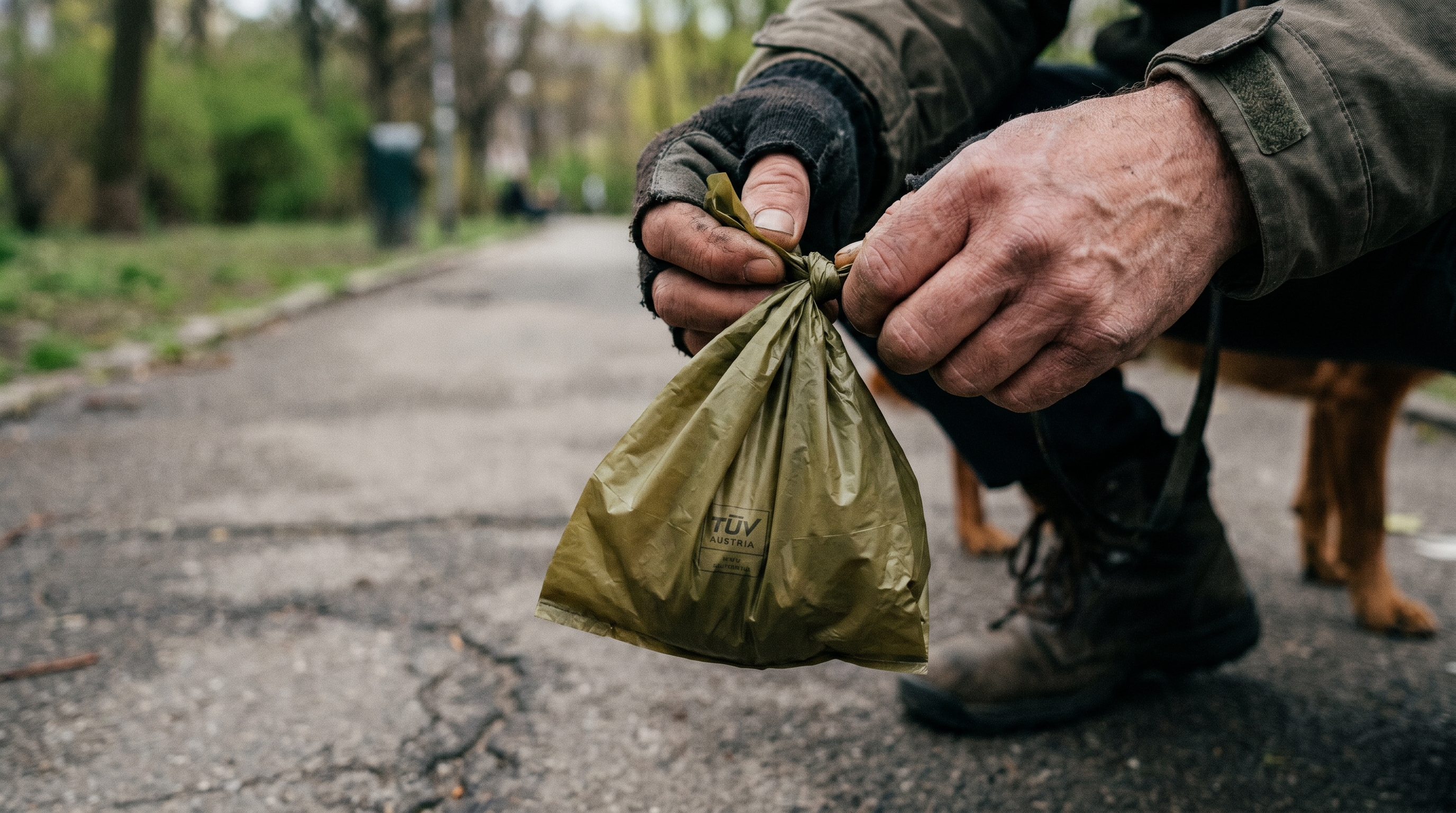
Compostable pet waste bags are certified to break down into carbon dioxide, water, and organic biomass under composting conditions. To carry that label with any credibility, a bag needs third-party certification tested against ASTM D6400 (the US standard) or EN 13432 (the European standard). “Biodegradable” has no equivalent requirement in the US. One word is regulated. The other is not.
You pull the bag from your pocket at 7am. Your dog is done. You tie it, you bin it. The whole sequence takes under two minutes. What takes considerably longer to answer is where that bag ends up, and whether the “compostable” claim on the roll means anything at all.
There are roughly 90 million pet dogs in the United States, each producing an estimated 274 pounds of waste per year. That adds up to millions of tons annually, almost all of it traveling to landfill wrapped in plastic. The bag material is the one variable you can actually change.
GIVE A SH!T® compostable poop bags are made from 18-micron plant-based film and are certified by TÜV Austria for both home and industrial compostability. But the certification is only useful if you know what you’re looking for. So here’s what you need to know.
Bag material: why the label on the packaging is not the whole story
Every bag you use for pet waste ends up in one of two places: landfill or compost. In landfill, standard polyethylene plastic takes an estimated 400 to 1,000 years to break down. Along the way, it leaches chemical additives into surrounding soil and fragments into microplastics that move through water systems. The US Environmental Protection Agency has flagged microplastic contamination from fragmented plastic products as a persistent environmental concern.
The labeling problem with bags marketed as “biodegradable” is mostly about enforcement. There isn’t any. In the US, the term has no binding legal definition for plastic products. Any material that degrades over any timeframe can technically use the word on its packaging. No test required. No timeline specified.
Oxo-degradable bags are a specific version of this problem. They contain chemical additives designed to accelerate fragmentation. They don’t biodegrade in any meaningful sense. They break into microscopic plastic particles that persist in soil and water. The US EPA and the European Commission have both raised concerns about oxo-degradable additives, and the EU restricted their use in single-use plastic products in 2019.
Certified compostable bags use a different material class entirely: plant-based film from corn starch, PBAT, and PLA. No fossil-fuel polymer. No oxo or EPI additives. Under the right conditions, that material converts to carbon dioxide, water, and biomass. The composting standard defines what “right conditions” means and sets measurable timelines to prove it.
Compostable vs. biodegradable: a distinction worth reading carefully
“Compostable” is held to a defined standard. ASTM D6400 (the US standard, last revised in 2021) and EN 13432 (the European standard, issued in 2000) both require the material to disintegrate by at least 90% within 180 days under industrial composting conditions, leaving no eco-toxic residue. That’s a pass/fail test with independent lab verification. You either meet it or you don’t get the cert mark.
“Biodegradable” has no equivalent. Any material that degrades over any timeframe can use the label on US packaging. No verification required. No timeline specified. This is why “certified compostable” and “biodegradable” are not interchangeable, even though they’re often sitting next to each other on the shelf at PetSmart.
Home composting certifications go further still. TÜV Austria’s OK Compost HOME standard tests at lower temperatures and longer timelines than the industrial test, matching the actual conditions of a backyard compost pile. A bag with only an industrial certification may not break down meaningfully in your garden bin. If home composting is your goal, OK Compost HOME is the mark that matters.
| Feature | Conventional plastic | “Biodegradable” (no cert) | 🛍️ GIVE A SH!T® compostable |
|---|---|---|---|
| Base material | Fossil-fuel polyethylene | Polyethylene + oxo additive | Plant-based: corn starch, PBAT, PLA |
| US certification standard | None required | None required | ASTM D6400 |
| Third-party certification | ❌ None | ❌ None | ✅ TÜV Austria (OK Compost HOME + INDUSTRIAL) |
| Disintegration timeline | 400-1,000 years (landfill) | Fragments into microplastics | 6 months (home composting) |
| Full biodegradation | Never (in any practical timeframe) | Does not biodegrade; fragments persist | 12 months (home composting) |
| PETA cruelty-free certified | ❌ | ❌ | ✅ |
Certification: the only verifiable proof of compostability
Third-party certification is the only way to verify a compostability claim. The main bodies to look for are TÜV Austria (OK Compost HOME and OK Compost INDUSTRIAL), BPI (Biodegradable Products Institute, US-focused), and DIN CERTCO (Germany-based, widely recognized in Europe). Each tests products independently against ASTM D6400 or EN 13432 standards.
GIVE A SH!T® bags carry both OK Compost HOME and OK Compost INDUSTRIAL certification from TÜV Austria. That dual certification means the bags meet the requirements for a real backyard pile and an industrial composting facility. Many certified bags on the market carry one standard or the other. All GIVE A SH!T® products are also PETA-certified cruelty-free through the Beauty Without Bunnies program.
If you’re reading a bag’s packaging and the words “TÜV Austria,” “BPI certified,” or “DIN CERTCO” don’t appear anywhere on it, the compostability claim is unverified. That’s not our opinion. It’s the test.
Compostable bag breakdown: the timeline and tested milestones
Two milestones determine the breakdown timeline, and they’re not the same thing.
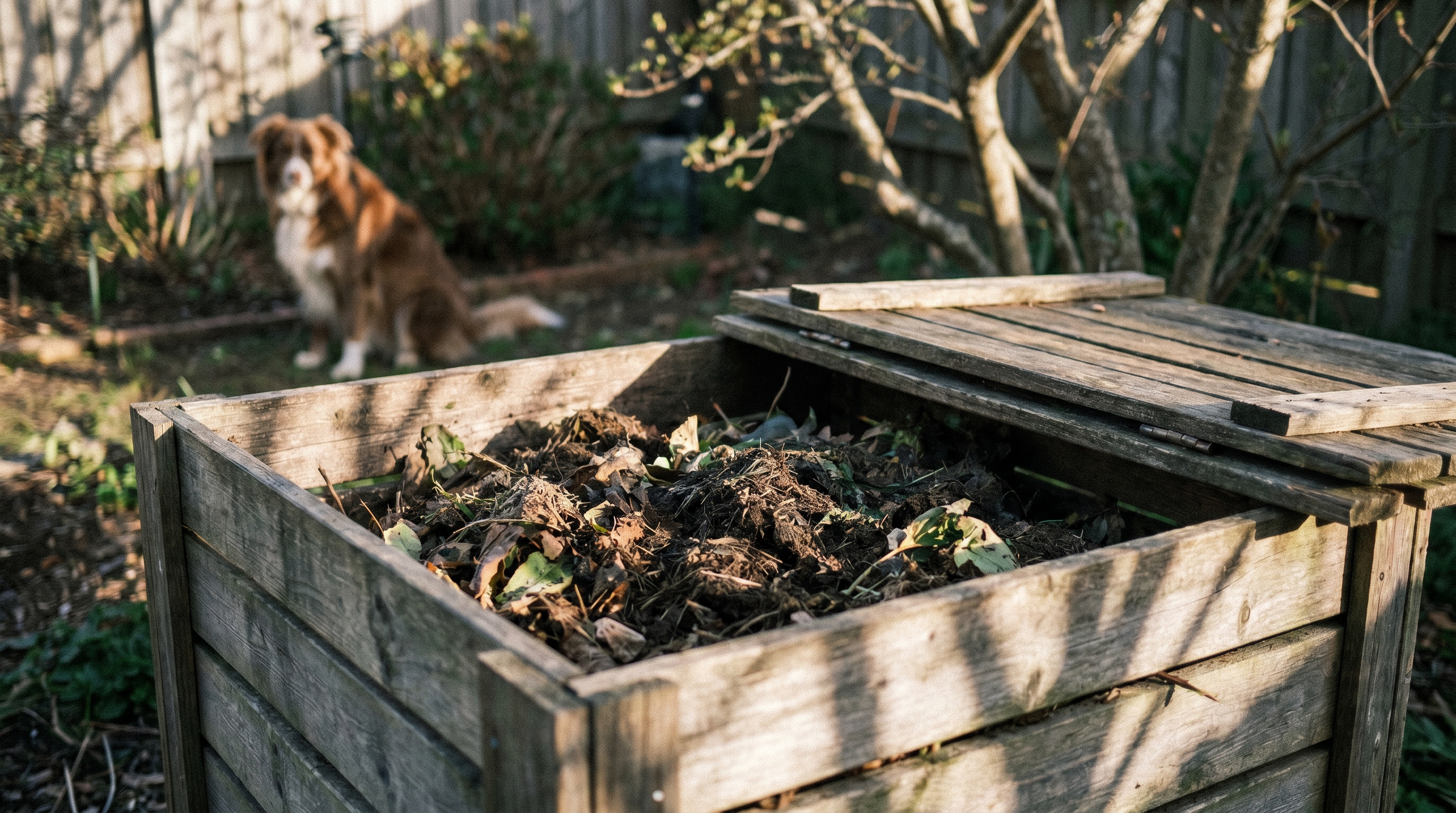
Disintegration is when the bag physically falls apart into pieces 2mm or smaller. At that point it’s no longer a recognizable bag. Under home composting conditions, GIVE A SH!T® bags reach this milestone within 6 months.
Full biodegradation is when the material has completely converted into carbon dioxide, water, and biomass, with no detectable residue. That takes up to 12 months under the same home composting conditions.
Under industrial composting conditions (higher temperatures, managed aeration), both milestones happen faster and fall within the 180-day window that ASTM D6400 requires.
A few practical notes. Dog waste is a pathogen risk, so most municipal composting facilities don’t accept pet waste even in certified bags. Check with your local facility before dropping bags in the green bin. Home composting is the more universally applicable route. And if you’re storing unused bags, GIVE A SH!T® bags have a 12-month shelf life. They’re stable under normal storage conditions.
Pet waste bags beyond dog walks: cats, small animals, and multi-pet homes
The same certified compostable film works across multiple pet-waste scenarios. Dog walks are the obvious use case. They’re not the only one.
For cat litter, GIVE A SH!T® makes two options. The XL compostable cat litter bags (17.7 x 11.8 inches, in packs of 30, 60, or 90) are sized for direct scooping and disposal. A Judge.me reviewer in April 2026 with four cats noted they were “great for holding a lot of waste” with handles that “make litter box cleaning that much easier.” The compostable tray liners (36 x 19 inches, with a built-in drawstring) are built for full litter box changes and jumbo boxes. Both carry TÜV Austria OK Compost HOME certification.
For small animals like rabbits, guinea pigs, or hamsters, the standard dog bag dimensions (13 x 9 inches in box format, 14 x 7 inches in pantry-roll format) work for cage cleanup. Same 18-micron plant-based film. Same TÜV certification. Same 10% of profits going to Soi Dog Foundation.
So yes: you pull the bag from your pocket at 7am and you wonder if it matters. It does. And if you’ve got three species and three different cleanup routines in one household, there’s a certified compostable option for each of them.
FAQ: compostable pet waste bags, answered
Compostable poop bags: are they strong enough for big dogs?
Durability is the most common concern among buyers of plant-based bags. A Zigpoll survey respondent in 2026 put it plainly: “Thin poop bags are not fun, especially if they rip easily.” GIVE A SH!T® bags are 18 microns thick. A Judge.me reviewer in May 2024 who owns a Great Dane described them as “thick enough to not tear” under heavy-use conditions. The bags are also leakproof and odor-locking by design.
Smell containment: will a compostable bag hold odor on a longer walk?
Odor containment is the second most common functional concern in buyer surveys. A Judge.me reviewer in September 2022 wrote: “These bags hold smell incredibly well.” The plant-based film has no built-in scent issue. Another reviewer noted they keep bags in the car for general spills because the odor seal is reliable. There are no added fragrances in GIVE A SH!T® bags, which is also why the reviewer who “gave away an entire box of horrible scented ones that just stink up my purse” (Judge.me, April 2026) switched.
Home composting: can I put a compostable poop bag in my backyard bin?
Yes, if the bag carries OK Compost HOME certification. GIVE A SH!T® bags are certified for home composting and will disintegrate within 6 months under backyard pile conditions, fully biodegrading within 12 months. The practical caveat is the waste itself. Dog feces introduces pathogens that a standard food-compost bin isn’t set up to neutralize. A dedicated pet-waste composter or a municipal facility that explicitly accepts pet waste is the safer route for the contents.
OK Compost HOME vs. OK Compost INDUSTRIAL: what’s the difference?
Both are TÜV Austria standards. Both require meeting EN 13432 or ASTM D6400. The difference is test conditions. Industrial testing runs at 55-60°C in managed, aerated facilities. OK Compost HOME tests at ambient temperatures of 20-30°C to simulate a real backyard pile. A bag with only an industrial certification may not biodegrade at home composting temperatures. GIVE A SH!T® bags carry both.
Verifying a bag: how do I know if the compostability claim is real?
Flip the packaging over. Look for a TÜV Austria seedling mark, a BPI certification logo, or a DIN CERTCO mark. Genuine certification marks include the issuing body’s name and usually a certification number you can cross-reference on that body’s public registry. If the packaging only says “biodegradable” or “compostable” without a named certifier, the claim is unverified. That’s the whole test, and it takes about 10 seconds.