

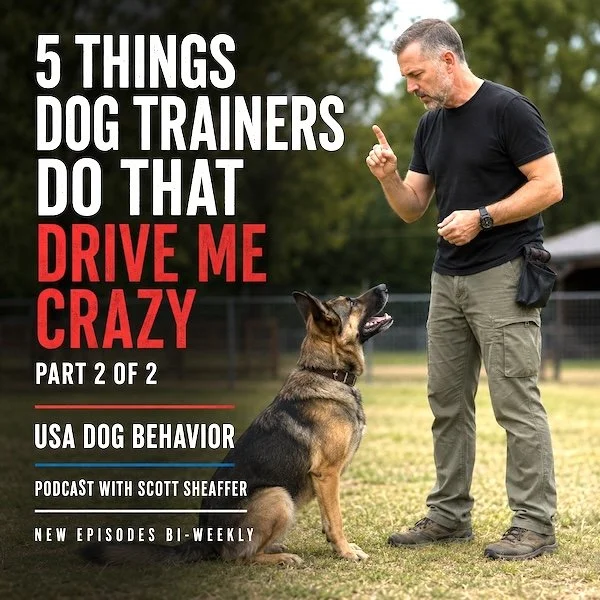
Prefer listening? This post is also available as an episode on the USA Dog Behavior Podcast—don’t forget to subscribe while you’re there if you haven’t already.
In the last episode, 5 Things Dog Owners Do That Drive Me Crazy, I had a little fun at the expense of dog owners. So, in the interest of fairness, this time I’m turning the spotlight on a segment of my own profession.
Most dog trainers I know genuinely care about dogs and want to help people. But dog training is still an unregulated field, and there are some practices and attitudes within the profession that concern me. Some are merely annoying. Others can create real problems for dogs and their owners.
Here are five of them.
1. Promising that everything can be fixed in a board-and-train program
Board-and-train programs can absolutely have value. A skilled trainer can accomplish a lot when working intensively with a dog. What drives me crazy is the promise that virtually any behavior problem can be “fixed” in two, three, or four weeks while the owner is somewhere else.
Dogs don’t behave in a vacuum. Behavior occurs in a particular environment, around particular people, and in response to particular triggers. A dog may learn beautiful leash manners with a professional trainer and still pull when the owner takes the leash. A dog that behaves calmly at a training facility may respond very differently when a stranger walks through the front door at home.
And every dog learns at their own pace. When a board and train sets a specific amount of time for the training, they are hoping that the dog will be ready and able to learn what needs to be learned in that specific amount of time. One thing I definitely know after working with thousands of dogs, they all learn at their own speed and rushing that virtually guarantees failure.
And serious problems such as fear, anxiety, resource guarding, and aggression aren’t simply obedience problems either.
The owner is always part of the behavior picture. In many cases, the owner needs to learn just as much or more than the dog does.
A good board-and-train program should therefore be viewed as only one part of a process, not as a magical reset button.
2. Using shock and prong collars as training tools
This one isn’t simply a personal preference. Modern behavioral science has increasingly moved toward reinforcement-based approaches and away from training methods that intentionally cause pain, fear, or discomfort.
The American Veterinary Society of Animal Behavior recommends reward-based methods for dog training and behavior modification and advises against aversive methods such as electronic shock collars and prong collars.
Can a shock collar suppress behavior? Of course it can. Pain and discomfort can change behavior. But stopping a behavior isn’t necessarily the same thing as treating the reason the behavior is occurring.
That distinction becomes especially important with fear and aggression. If a dog growls because he’s frightened and we punish the growl, we may suppress an important warning signal without changing the fear underneath it, or make the underlying fear worse.
My goal isn’t simply to make behavior disappear. It’s to understand why it’s happening and address that cause as humanely and effectively as possible.
3. Taking aggression cases they aren’t qualified to handle
This is probably the one that concerns me most. Teaching a dog to sit, stay, walk politely on leash, or come when called is fundamentally and substantially different from evaluating a dog that has bitten someone.
Human-directed aggression involves questions of risk, safety, history, triggers, predictability, management, prognosis, and sometimes medical or medication considerations. Mistakes can have serious consequences.
There is absolutely nothing wrong with a trainer saying, “This case is outside my area of expertise.” In fact, I think that’s a sign of professionalism. The best professionals I know aren’t afraid to refer. They know what they know, and they also know what they don’t know.
[This article is original content created by USA Dog Behavior (https://www.USADogBehavior.com)
4. Trying to be everything to everybody
This is related to number three. I occasionally see businesses offering obedience training, puppy classes, daycare, boarding, grooming, dog walking, board-and-train programs, separation anxiety treatment, aggression treatment, service-dog training, and behavior consulting. That’s an enormous range of disciplines.
There’s nothing inherently wrong with a business providing multiple services, particularly if different qualified people are responsible for different specialties. But one person or a very small business simply cannot be an expert at everything.
The deeper I’ve gone into serious canine behavior problems, particularly aggression, the more obvious that has become to me. Specialization isn’t a weakness. It’s what eventually happens in almost every mature profession.
You don’t want your family doctor performing your brain surgery. Dog behavior isn’t medicine, obviously, but the principle is the same: sometimes you need a specialist.
5. Never opening a serious book on dog training or behavior
Experience matters tremendously. But experience without education has a serious limitation: we can become very good at repeatedly observing something and still misunderstand why it’s happening.
“I’ve worked with dogs for 20 years” tells me someone has worked with dogs for 20 years. It doesn’t automatically tell me what they’ve learned during those 20 years.
The behavior field includes learning theory, ethology, genetics, development, neurobiology, stress, fear, animal welfare, communication, medication, and the effects of environment on behavior.
That doesn’t mean every trainer needs a PhD in animal behavior or one of the millions of certifications available today (some better than others), but it does mean that observation should be informed by education.
The best dog professionals I’ve encountered remain students throughout their careers. They read. They attend seminars. They study research. They talk to people who know more than they do. And occasionally, they discover that something they believed ten years ago was wrong. That’s professional growth.
Wrap-Up
So those are five things dog trainers do that drive me crazy. And unlike the last episode, I can’t blame dog owners for any of them!
The common thread is really pretty simple: good dog training requires a degree of humility. We should be cautious about promising quick fixes, thoughtful about the methods we use, honest about the limits of our expertise, willing to specialize or refer when appropriate, and committed to continuing to learn.
Dogs deserve that, and so do the people who trust us to help them.
Prefer listening? This post is also available as an episode on the USA Dog Behavior Podcast—don’t forget to subscribe while you’re there if you haven’t already.
© 2026 Scott Sheaffer. All rights reserved. Original content. Reproduction prohibited.