

Eggs don’t need butter, cheese, or seasoning to smell irresistible to a dog. This simple veggie egg scramble combines fully cooked eggs with small pieces of carrot, zucchini, and green beans for a colorful homemade topper you can prepare in about 10 minutes.
The important word here is topper. Although these ingredients are suitable for many healthy adult dogs, this recipe is not formulated to provide every nutrient a dog needs. Serve a small amount over complete and balanced dog food, or offer it occasionally as a special treat.
Why You’ll Love This Recipe
This veggie egg scramble is:
- Prepared with four simple ingredients
- Ready in approximately 10 minutes
- Free from salt, butter, cheese and seasonings
- Easy to divide into small portions
- Suitable as an occasional treat or food topper
- Easy to customize with other dog-safe vegetables
The eggs are cooked completely, while the vegetables are finely chopped and softened to make them easier for your dog to eat.
According to the American Kennel Club, eggs can be safely offered to dogs when they are fully cooked. Plain green beans and zucchini can also be suitable for dogs when served without salt, oils, sauces or seasonings.
However, your dog’s regular complete and balanced food should remain the foundation of their diet.
Veggie Egg Scramble for Dogs Recipe
How to Make Veggie Egg Scramble for Dogs
Step 1: Prepare the Vegetables
Wash the carrot, zucchini and green beans thoroughly.
Peel the carrot, then finely dice or grate it. Cut the zucchini and green beans into similarly small pieces.
Keeping the pieces small helps the vegetables soften more quickly and makes the finished scramble easier for your dog to eat.
Step 2: Soften the Vegetables
Place a small nonstick skillet over medium-low heat.
Add the prepared vegetables and one tablespoon of water. Cook for approximately 3–4 minutes, stirring frequently.
If the skillet becomes dry before the vegetables have softened, add another small splash of water.
The vegetables should become tender without browning or burning.
Step 3: Beat the Eggs
Crack the eggs into a clean mixing bowl.
Add the remaining tablespoon of water and whisk until the yolks and whites are completely combined.
Do not add milk, cream, salt, pepper or other seasonings.
Step 4: Cook the Eggs Completely
Pour the beaten eggs over the softened vegetables.
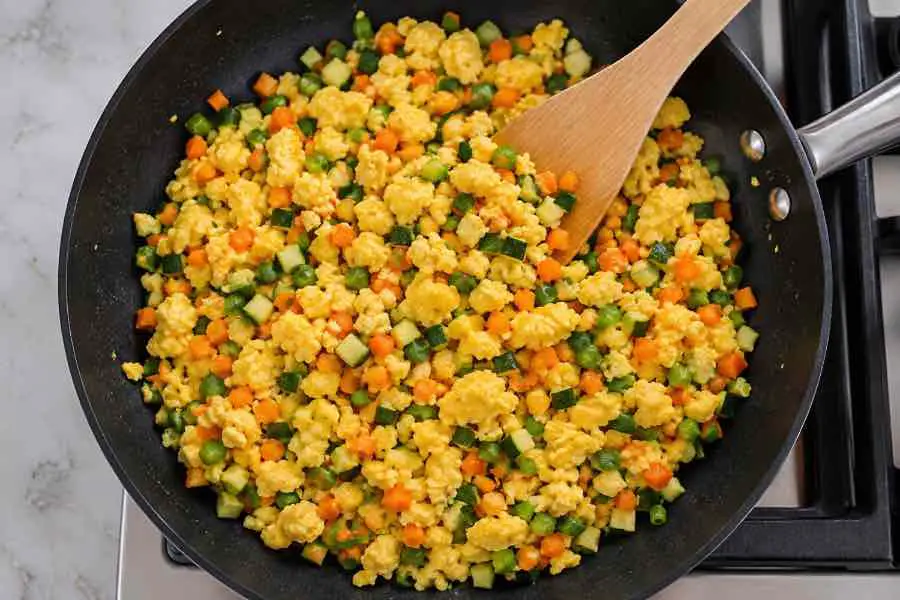
Use a silicone or wooden spatula to stir the mixture slowly as the eggs cook. Continue cooking for approximately 2–3 minutes, or until the eggs have formed soft curds and no liquid egg remains.
The scramble should be fully cooked but not dry or browned.
Step 5: Cool Before Serving
Transfer the cooked scramble to a clean plate or shallow bowl.
Allow it to cool completely before offering it to your dog. Break up any unusually large pieces and check the temperature carefully before serving.
Never give your dog food directly from a hot skillet.
How Much Veggie Egg Scramble Can I Give My Dog?
There is no single serving size that is suitable for every dog. The correct amount depends on your dog’s:
- Body size
- Weight
- Age
- Activity level
- Daily calorie needs
- Health conditions
- Regular diet
The entire recipe contains approximately 155 calories. Feeding the full batch at once could provide far too many additional calories, particularly for a small dog.
All treats, toppers and other extras should account for only a small percentage of your dog’s daily calorie intake. A commonly used guideline is to keep treats and extras to no more than approximately 10% of daily calories.
If you add this scramble to your dog’s normal meal, consider slightly reducing the regular food portion so you are not simply adding unnecessary calories.
When offering the scramble for the first time, begin with a very small taste. Watch your dog for signs of a reaction, including:
- Vomiting
- Diarrhea
- Excessive gas
- Itching
- Facial swelling
- Unusual tiredness
- Loss of appetite
Stop feeding the recipe and contact your veterinarian if your dog develops concerning symptoms.
Place the food-topper image here.
Suggested alt text: A small spoonful of veggie egg scramble served over a beagle’s regular dog food.
Suggested caption: Serve the scramble as a modest topper rather than using it to replace a complete and balanced meal.
Why These Ingredients Are Used
Fully Cooked Eggs
Eggs provide protein and several important nutrients. They are also naturally aromatic, which can make a small amount appealing to dogs that occasionally need encouragement to eat.
Eggs should always be fully cooked before being served. Do not use raw or undercooked eggs in this recipe.
Eggs also contain calories and fat, so more is not necessarily better. Dogs with egg allergies, pancreatitis or medically prescribed low-fat diets may need to avoid them.
Carrots
Plain carrots are commonly used in dog treats and food toppers. Their mild sweetness complements the eggs, while their bright orange color makes the scramble look more appealing.
Peeling and finely chopping or grating the carrot helps it soften during the short cooking time.
Zucchini
Zucchini has a mild flavor and softens quickly when cut into small pieces.
The AKC’s zucchini guidance notes that plain zucchini can be given to dogs in moderation. As with other vegetables, it should be prepared without harmful seasonings.
Green Beans
Plain green beans can add texture and color without contributing many calories.
Fresh, frozen or no-salt-added canned green beans may be used. Regular canned green beans can contain significant amounts of sodium, so always check the label.
The American Kennel Club advises serving green beans plain and avoiding recipes prepared with unsafe additional ingredients.
Ingredients You Should Never Add
Scrambled eggs prepared for people often contain ingredients that should not be added to your dog’s portion.
Keep this recipe completely plain and leave out:
- Onion
- Garlic
- Chives
- Leeks
- Salt
- Pepper
- Spice blends
- Hot sauce
- Butter
- Bacon grease
- Excess cooking oil
- Cheese
- Cream
- Ketchup
- Processed meat
- Bacon
- Sausage
- Ham
Onion, garlic, chives and leeks belong to the Allium family. These ingredients can be dangerous to dogs.
According to the ASPCA’s list of people foods pets should avoid, onion, garlic and chives can cause gastrointestinal irritation and damage red blood cells.
Do not assume that sharing a small amount of your own seasoned breakfast is automatically safe. Cook your dog’s portion separately before adding butter, salt, cheese, seasoning or sauces to the human portion.
Safe Recipe Substitutions
You can occasionally change the vegetables without making the recipe unnecessarily complicated.
Replace one vegetable with the same quantity of one of these plain, cooked alternatives:
- Finely chopped broccoli florets
- Plain pumpkin purée
- Cooked and mashed sweet potato
- Finely chopped peas
Make sure pumpkin purée contains only pumpkin. Do not use pumpkin pie filling, which may contain sugar, spices and other unsuitable ingredients.
Change only one ingredient at a time. This makes it easier to identify the cause if your dog develops digestive upset or another reaction.
Avoid using spinach regularly, particularly if your dog has kidney disease or a history of bladder or kidney stones. The AKC notes that spinach contains significant amounts of oxalic acid and recommends consulting a veterinarian before adding it to a dog’s diet.
How to Store the Scramble
Let the leftover scramble cool before transferring it to a clean, airtight container.
Refrigerating
Keep the scramble refrigerated and use it within three days.
Remove only the portion you intend to serve rather than repeatedly warming and cooling the entire batch.
Freezing
Divide the scramble into small portions and freeze them for up to one month for the best quality.
A silicone ice-cube tray can make portioning convenient. Once frozen, transfer the portions to a labeled freezer-safe container.
Thawing
Thaw frozen portions overnight in the refrigerator.
Do not leave the scramble on the counter for several hours to thaw.
Reheating
You can serve the scramble chilled if your dog enjoys it.
If you prefer to warm it, heat it only until gently warm. Stir thoroughly and check the temperature before putting it in your dog’s bowl, as microwaves can create dangerously hot areas.
Discard cooked scramble that has remained at room temperature for longer than two hours.
When to Ask Your Veterinarian First
Speak with your veterinarian before offering this recipe if your dog:
- Has a known egg or food allergy
- Has experienced pancreatitis
- Requires a strictly controlled fat intake
- Has kidney or urinary disease
- Has gastrointestinal disease
- Is overweight or following a calorie-restricted plan
- Eats a prescription or therapeutic diet
- Is a puppy
- Is pregnant or nursing
- Has recently experienced vomiting or diarrhea
- Has a poor appetite
- Has unexplained weight loss
- Has another chronic health condition
Homemade recipes should not replace a complete diet unless the recipe has been specifically formulated for your dog by a board-certified veterinary nutritionist.
The World Small Animal Veterinary Association’s nutrition resources emphasize the importance of individualized nutrition planning with your veterinary healthcare team.
Frequently Asked Questions
Can Dogs Eat Scrambled Eggs?
Many dogs can eat fully cooked, unseasoned scrambled eggs in moderation.
Do not add butter, salt, onion, garlic, cheese, milk, cream or seasoning. Remember that eggs contain calories and may not be suitable for dogs with certain allergies or medical conditions.
Can My Dog Eat This Scramble for Breakfast?
You can occasionally serve it as a breakfast treat or add a small amount to your dog’s usual morning meal.
However, it should not regularly replace complete and balanced dog food. Eggs and vegetables alone do not provide every essential nutrient in the appropriate proportions.
Can I Make This Recipe With Only Egg and Carrot?
Yes. You can make a simpler version using only fully cooked egg and softened carrot.
Keep the serving small and avoid adding butter, oil, salt or seasoning.
Can Puppies Eat Veggie Egg Scramble?
Puppies have precise nutritional requirements to support healthy growth and development.
Ask your veterinarian before adding homemade foods to a puppy’s diet. Never use this recipe to replace properly formulated puppy food.
Can I Use Oil in the Skillet?
A good nonstick skillet and a small amount of water should prevent sticking.
If oil is genuinely necessary, apply only the thinnest film of a dog-appropriate cooking oil. Remember to account for the additional calories.
Avoid butter, bacon grease and large amounts of oil.
Can I Add Cheese?
It is better to leave cheese out.
Cheese adds fat, sodium and calories, and some dogs do not tolerate dairy products well. The eggs and vegetables already make the recipe aromatic and flavorful without it.
Can I Add Eggshell for Calcium?
Do not casually add ground eggshell or another calcium supplement.
Calcium must be balanced carefully with phosphorus and other nutrients, particularly for puppies and dogs eating homemade diets.
If your dog requires a completely homemade diet, ask a veterinary nutritionist to create an appropriate formulation rather than improvising nutritional supplements.
Can I Serve the Entire Batch?
The full batch contains approximately 155 calories and will be too much as a treat for many dogs, especially small dogs.
Divide it into appropriate portions based on your dog’s size, daily calorie allowance, health and regular diet.
Can I Use This Recipe for a Picky Dog?
A small spoonful may make regular dog food smell and taste more appealing. However, ongoing appetite loss or a sudden change in eating habits can indicate an underlying medical problem.
Contact your veterinarian if your dog repeatedly refuses meals, loses weight or displays additional symptoms.
Final Thoughts
The best dog-friendly recipes are often the least complicated.
Cook the eggs thoroughly, soften and finely chop the vegetables, leave out every seasoning and serve only a small amount. Used responsibly, this veggie egg scramble can add aroma, color and variety to your dog’s bowl without replacing the balanced food they rely on.
Always introduce new ingredients gradually and consider the calories in treats and toppers when calculating your dog’s total daily food intake.
Veterinary disclaimer: This recipe and article provide general educational information and are not substitutes for professional veterinary advice. Every dog has different nutritional and medical requirements. Consult your veterinarian before making significant changes to your dog’s diet.
Checkout Our Favorite Dog Products
1. BEST PUPPY TOY
We Like: Snuggle Behavior Toy with Heart Beat & Heat Pack – Ideal toy for new puppies.
2. BEST DOG TRAINING PROGRAM
We Like: Doggy Dan The Online Dog Trainer – Stop any dog problem and raise the perfect puppy with The Online Dog Trainer.
3. BEST DOG DNA TEST
We Like: Embark Dog DNA Test – Embark screens for over 250 dog breeds + tests for 170+ genetic diseases including MDR1 drug sensitivity, glaucoma, degenerative myelopathy, and dilated cardiomyopathy, some of the most common adult-onset diseases in dogs.
4. BEST DOG PUZZLE TOY
We Like: Outward Hound Interactive Puzzle Toy – Every dog loves chasing squirrels at the park. The Outward Hound Hide-a-Squirrel Puzzle Toy gives your dog the same feeling as though he was outdoors chasing live squirrels.
5. Best Calming Treats for Dogs
We Like: FurroLandia Hemp Calming Treats – These soft chews will calm your dog so it can peacefully endure stressful situations, such as long car trips, visiting unfamiliar places, or hearing Thunder. Ideal for all dog breeds & sizes.
Image alt text:
Featured image: Veggie egg scramble for dogs in a ceramic bowl with a golden retriever waiting behind it
Cooking image: Fully cooked egg, carrot, zucchini and green bean scramble in a nonstick skillet
Topper image: Small spoonful of veggie egg scramble served over a beagle’s regular dog food