

When you purchase through links on our site, we may earn a commission at no extra cost to you. Learn more.
This is a classic scene after I take my dog for a walk.
He comes inside, flops onto the rug like life has been especially hard on him, and pants with his tongue hanging out like he’s just finished the adventure of a lifetime. It’s funny. It’s familiar. And after a good walk, it makes perfect sense.
But sometimes, he does the same thing when nothing much has happened at all.
The room is cool. The house is quiet. And yet, there he is. Stretched out on the rug, doing absolutely nothing… still going pant, pant, pant.
That’s when I stop and wonder: Why is my dog panting so much for no reason?
Sometimes it’s completely normal. Other times, it can be a subtle sign that something feels off.
Because with dogs, even a little panting can tell a bigger story.
Why Do Dogs Pant?
Unlike humans, dogs cannot cool themselves by sweating through their skin. They only have a small number of sweat glands in their paw pads, which is not nearly enough to regulate body temperature on its own.
So instead, dogs pant.
Panting is your dog’s built-in cooling system. As air moves quickly over the moist surfaces of the tongue, mouth, and upper airways, that moisture evaporates and helps release excess heat from the body. Think of it like a natural radiator: simple, effective, and constantly working to keep your dog from overheating.
That is why panting is so common after:
- Walks
- Playtime or zoomies
- Warm weather
- Excitement
Most of the time, this is completely normal. If your dog has been active, stimulated, or out in the heat, panting is usually just their body doing what it was designed to do.
But panting is not always about cooling down.
Dogs may also pant when they are stressed, anxious, in pain, nauseated, or dealing with an underlying medical issue. In other words, panting can be completely harmless, or it can be one of the first subtle signs that something is off.
That is why context matters so much. The real question is not just whether your dog is panting, but when it happens, how long it lasts, and what else is going on around them.
The video below shows normal panting:
Normal vs. Abnormal Panting
Before getting into the possible causes, it helps to know what normal panting looks like—and what should raise concern.
Normal Panting
Normal panting usually has a clear reason and settles on its own.
It often happens after exercise, during warm weather, or in moments of excitement. Your dog may have their tongue out and be breathing quickly, but they still look relaxed, alert, and comfortable.
Normal panting usually:
- Happens after activity, heat, or excitement
- Looks quick but steady
- Comes with a relaxed posture and bright eyes
- Improves after rest, water, or cooling down
Abnormal Panting
Abnormal panting tends to feel out of place. It may start when your dog is resting, happen in a cool room, or sound harsher and more labored than usual.
It is often the change in context that matters most.
Red flags include panting that:
- Happens at rest with no obvious trigger
- Starts in a cool or air-conditioned room
- Sounds loud, raspy, wet, or strained
- Does not improve with rest
- Comes with pale, blue, brick red, or white gums
- Looks more intense than your dog’s usual baseline
If panting seems unusual for your dog, trust that instinct. Normal panting makes sense. Abnormal panting usually does not.
If you are trying to figure out whether your dog’s panting is normal or something more serious, this quick comparison can help. While every dog is different, these general ranges give you a helpful baseline for what is typical, and what may signal an emergency.
| Feature | Normal Range | Emergency Signs |
|---|---|---|
| Breathing Rate | 15–30 breaths/min (Resting) | Over 40–60 breaths/min |
| Gum Color | Bubblegum Pink | Blue, Purple, or Brick Red |
| Body Temperature | 101.0°F – 102.5°F | 105.0°F+ (Heatstroke Zone) |
| Panting Sound | Quiet, rhythmic huffing | Rasping, “Honking,” or Labored |
| Hydration/Saliva | Thin, watery saliva | Thick, “ropey” saliva or foaming |
If your dog is showing multiple red flags, especially labored breathing, abnormal gum color, or extreme heat, seek veterinary care immediately.
5 Reasons Your Dog Is Panting So Much (And When to Worry)
When panting happens outside of expected situations, or becomes more intense, frequent, or prolonged, it can signal underlying physical or emotional stress. In some cases, it may be one of the earliest signs of a more serious health issue.
Understanding the possible cause is the first step in knowing when to monitor it and when to worry.
1. Breed and Anatomy: The “Built-In” Struggle
Some dogs are naturally more prone to panting because of the way their bodies are built.
Flat-faced, or brachycephalic, breeds, including Pugs, French Bulldogs, English Bulldogs, and Boston Terriers, have shortened skulls that compress the nasal passages and upper airway. That reduced space makes airflow less efficient and breathing more labor-intensive.
As a result, these dogs often have to work harder just to breathe normally. They also rely more heavily on panting, even in situations that might not bother other breeds.
Veterinary experts point out that brachycephalic dogs are not just “loud breathers.” Their upper airways are physically narrowed, which makes airflow less efficient and forces them to work harder with every breath. That reduced efficiency also impacts how well panting can cool them down.
This condition, known as Brachycephalic Obstructive Airway Syndrome (BOAS), is widely recognized by the American Animal Hospital Association. It explains why these dogs often pant more—and why they can overheat faster than other breeds.
While we love their smooshed faces, their internal plumbing is basically a studio apartment’s worth of tissue crammed into a walk-in closet.
Why this matters:
- Panting may be more frequent even at baseline
- Airflow restriction makes cooling less efficient
- These breeds are more vulnerable to heat stress and heatstroke
- Breathing issues can escalate faster than they do in other dogs
For owners of flat-faced breeds, the key is not just noticing panting itself, but paying attention to how hard the dog seems to be working to breathe, how quickly they recover, and whether the panting seems heavier than usual for that individual dog.
2. Emotional Panting: Stress, Anxiety, and Fear
Panting is not always about temperature. Sometimes it is driven by emotion.
When a dog feels anxious, frightened, or overwhelmed, the body activates the fight-or-flight response. Stress hormones like adrenaline and cortisol rise, the heart beats faster, and breathing speeds up to increase oxygen delivery. In that moment, the dog may pant heavily even though they are not hot at all.
Veterinary behaviorists often call this behavioral panting. It is a stress response triggered by the sympathetic nervous system. If panting is paired with shaking or trembling, it is much more likely to be fear-related than heat-related.
This kind of panting is often tied to context. It may happen during car rides, veterinary visits, thunderstorms, fireworks, or other situations the dog finds unsettling.
Signs of stress-related panting can include:
- Rapid, shallow breathing
- A tense facial expression
- Whining or trembling
- Pacing or difficulty settling down
- Pinned-back ears or wide, worried eyes
Unlike normal cooling panting, emotional panting often looks tighter and more uneasy. The dog may seem restless or hyper-aware of their surroundings, and the panting usually will not improve simply because the room is cool.
That is why context matters so much. If your dog only pants heavily in certain places or during certain events, anxiety may be the real trigger.
3. Heatstroke: A Medical Emergency
This is one of the most serious reasons a dog may pant excessively.
Under normal conditions, panting helps a dog regulate body temperature through evaporation. But in extreme heat, high humidity, or after too much exertion, that internal cooling system can stop being enough. When that happens, the dog’s body temperature begins to rise faster than they can control it.
That is when overheating can become heatstroke.
Once a dog reaches this stage, panting is no longer just a cooling response. It is a sign that the body is struggling to keep up. Internal temperature may continue rising to dangerous levels, which can lead to organ damage, collapse, and even death without prompt treatment.
One notable warning sign is what some owners describe as a “spatula tongue”—when the tongue appears wider and flatter than usual as the dog tries to maximize surface area for cooling.
Cornell College of Veterinary Medicine notes that a dog’s normal temperature is typically 101°F to 102.5°F, while heatstroke begins around 105.8°F or higher. At that point, panting is no longer enough to keep up, and the risk of organ damage rises quickly.
Warning signs of heatstroke may include:
- Frantic or extremely heavy panting
- A flattened, widened tongue
- Bright red gums
- Excessive drooling
- Weakness, stumbling, or collapse
- Vomiting or diarrhea
- Disorientation or unusual lethargy
Why immediate action matters:
- Heatstroke can cause irreversible organ damage
- Dogs cannot simply “rest it off” once symptoms become severe
- Veterinary care is often needed to stabilize body temperature safely
If a dog is showing signs of heatstroke, time matters. Heavy panting in this context should always be treated as urgent.
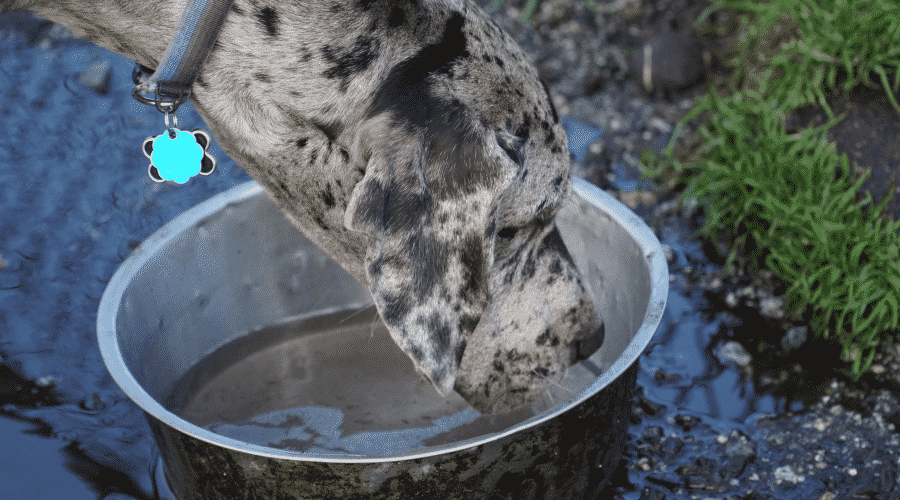
The Myth: “Just Give Them Water and They’ll Cool Down”
When your dog is panting, it is natural to reach for the water bowl. And yes, water matters. It helps with hydration and can support recovery after mild activity or heat.
But water alone is not a fix.
Myth: Giving your dog water will cool them down.
Reality: Water helps with hydration, but it will not fix overheating, heatstroke, pain, or breathing distress on its own. If your dog is panting hard, move them to a cool space, offer water, and watch for red flags. If the panting does not improve, call your vet.
4. Age-Related Causes: Senior Dogs and Pain
As dogs get older, panting can become more frequent for reasons that are not always obvious.
One of the most common causes is pain, especially from arthritis or other chronic joint issues. Dogs are often remarkably stoic, which means they may not yelp, limp dramatically, or make their discomfort obvious. Instead, they show it in quieter ways, such as restlessness, pacing, or increased panting.
This is especially common at night.
Many owners notice that their senior dog seems unable to settle in the evening, gets up and down repeatedly, or begins panting once the house becomes quiet. Without daytime distractions, discomfort may become more noticeable, and the panting starts.
Pain-related panting may be accompanied by:
- Difficulty getting comfortable
- Frequent position changes
- Stiffness or slower movement
- Panting that worsens during rest
- Nighttime pacing or inability to settle
In senior dogs, nighttime panting can also be linked to canine cognitive dysfunction (CCD), a condition similar to dementia. Some older dogs become more confused or anxious as evening falls, a pattern often compared to sundowning in people. That confusion can lead to restlessness, whining, and anxiety-related panting.
Age-related panting may be linked to:
- Arthritis or joint pain
- General chronic discomfort
- Cognitive decline
- Age-related anxiety or nighttime confusion
Another condition to keep on the radar is laryngeal paralysis, which is especially common in older Labradors and Golden Retrievers. It can create an abrasive, raspy, or “honking” sound because the airway does not open fully during breathing.
When a senior dog starts panting more than usual, especially at night, it is often worth looking beyond age alone and considering whether pain or cognitive changes may be part of the picture.
5. Underlying Medical Conditions: The “Silent” Triggers
Sometimes panting is not caused by heat, excitement, or obvious stress at all. Instead, it can be one of the first signs of an underlying medical condition.

Veterinary references like the Merck Veterinary Manual list effortful breathing, abnormal respiratory sounds, and gum color changes as signs of respiratory distress. That is one reason persistent panting should always be looked at in context.
- One common example is Cushing’s disease, a hormonal disorder that causes the body to produce too much cortisol. Since cortisol is closely tied to the stress response, dogs with Cushing’s often pant more than usual, even while resting.
That “resting pant” can feel especially confusing to owners because the dog is not active, hot, or obviously distressed. But elevated cortisol can directly increase panting even when everything else seems calm.
- Heart and lung problems can also lead to abnormal panting. If the heart is not pumping efficiently or the lungs are not exchanging oxygen properly, the body may try to compensate by increasing breathing rate and effort.
- Other issues, such as anemia, can reduce the blood’s ability to carry oxygen. In those cases, the dog may pant because the body is trying to make up for that oxygen shortfall.
And in some situations, sudden heavy panting can be a sign of toxicity. Dogs that ingest something harmful, such as chocolate, onions, xylitol, or certain medications, may begin panting as one of the earliest visible signs that something is wrong.
Potential medical causes of excessive panting include:
- Cushing’s disease
- Heart disease
- Lung disease or respiratory illness
- Anemia
- Toxicity or poisoning
- Other hormonal or metabolic disorders
Panting is more concerning when it appears alongside:
- Lethargy or weakness
- Coughing
- Labored breathing
- Pale, blue, or very bright red gums
- Vomiting
- Loss of appetite
- Sudden behavior changes
In these cases, panting is not the root issue, it is the symptom. And sometimes it is the clue that leads to a much bigger diagnosis.
When to Worry About Panting
Panting becomes more concerning when it is out of proportion to the situation or does not fit your dog’s normal pattern.
You should pay closer attention if your dog is panting:
- At rest, with no clear trigger
- In a cool room or a comfortable environment
- More intensely or for longer than usual
- With visible effort, such as heaving sides or flared nostrils
- Alongside weakness, drooling, pacing, coughing, or gum color changes
- In a way that feels unusual for your dog’s normal baseline
The most important thing to remember is this: normal panting makes sense.
It has a reason. It follows a pattern. And it usually settles once your dog cools down, calms down, or rests.
When panting feels random, persistent, unusually intense, or paired with other symptoms, it is worth taking seriously. In many cases, it is your dog’s way of telling you that something deeper may be going on.
What Can You Do If Your Dog Is Panting Excessively?
If your dog is panting more than usual, it is natural to feel concerned. The good news is that in many cases, there are simple things you can do right away to help them feel more comfortable while you figure out what is going on.
The key is to look at the situation, stay calm, and respond based on what your dog may need in that moment.
Start with the basics
If your dog may be overheated or overstimulated, start by helping them cool down and relax.
- Move your dog to a cool, shaded, or air-conditioned area
- Offer fresh, cool (not ice-cold) water
- Encourage them to rest in a quiet space
- Avoid further exercise or stimulation
In many cases, normal panting should begin to slow once your dog has a chance to rest and cool off.
Look at the context
Take a moment to ask yourself what may have triggered the panting.
- Was your dog just active or outside in the heat?
- Are they in a stressful or unfamiliar environment?
- Is there a recent change in routine, noise, or surroundings?
Sometimes the cause is simple, and removing the trigger can resolve the panting quickly.
Help reduce stress or anxiety
If your dog seems nervous or overwhelmed, focus on helping them feel safe.
- Move them away from loud noises or stressful situations
- Stay calm and use a reassuring tone
- Offer a familiar space, bed, or comfort item
- Avoid forcing interaction if they seem unsettled
For some dogs, stress-related panting will ease once they feel more secure.
Watch for signs of pain or illness
If your dog is panting at rest or behaving differently than usual, pay close attention to other symptoms.
- Restlessness or inability to get comfortable
- Lethargy or unusual fatigue
- Coughing or labored breathing
- Changes in appetite or behavior
- Gum color changes (pale, blue, or very red)
Panting combined with any of these signs may indicate an underlying issue that needs attention.
When to Call the Vet (The “Rule of 30”)
It can be nerve-wracking to watch your dog huff and puff without an obvious reason. While many causes of panting are manageable, some are time-sensitive. If you aren’t sure whether to worry, use the Rule of 30:
If your dog is in a cool environment, has access to water, and has been resting for 30 minutes but is still panting heavily, it’s time to call the vet.
The “Emergency” Checklist
Stop reading and head to an emergency clinic immediately if the panting is accompanied by:
- Blue, purple, or white gums (a sign of oxygen deprivation).
- Extreme lethargy or an inability to stand up.
- A “honking” or whistling sound with every breath.
- Persistent vomiting or a bloated, hard abdomen.
Final Pro-Tip: Record the Behavior
If the panting is intermittent (it comes and goes), try to film a 30-second clip on your phone. Dogs often stop their “weird” behaviors the second they walk into a vet’s office. Showing your vet a video of the rhythm and sound of the panting at home is often the fastest way to get an accurate diagnosis.
At the end of the day, you know your dog better than any algorithm or article. If your gut tells you their breathing has changed, trust that instinct. It’s always better to have a “false alarm” at the vet than to miss a signal that your best friend is in distress.
Frequently Asked Questions
If you are still wondering whether your dog’s panting is normal, you are not alone. These are some of the most common questions dog owners ask. If you do not see your question here, feel free to drop it in the comments.
Why is my dog panting when they have not been exercising?
If your dog is panting even though they have not been walking, playing, or out in the heat, there is usually a reason behind it. Dogs may pant because of stress, pain, nausea, fear, or an underlying medical issue. When panting happens at rest or in a cool room, it is worth paying closer attention to what else is going on.
Why is my dog panting at night while resting?
Nighttime panting is a classic sign of either physical discomfort (like arthritis pain) or cognitive anxiety. In older dogs, it’s often “sundowning,” where confusion increases as the light dims. If your dog is also pacing or can’t seem to settle into a comfortable position, it’s likely a sign of joint pain that should be discussed with your vet.
When should I worry about my dog panting a lot?
Panting a lot can be normal after exercise, excitement, or warm weather. It becomes more concerning when it seems excessive, lasts longer than expected, happens at rest, or is paired with other symptoms like drooling, weakness, coughing, pacing, or changes in gum color. In those cases, it may be a sign that something more serious is going on.
Why is my dog constantly panting?
Constant panting is usually more concerning than brief panting after activity. It can sometimes be linked to chronic pain, anxiety, overheating, Cushing’s disease, heart problems, lung disease, or other medical conditions. If your dog seems to be panting constantly and it is unusual for them, it is a good idea to have them checked by a veterinarian.
Can certain medications cause excessive panting?
Some can. If your dog has recently started a new medication, particularly Prednisone or other steroids, heavy panting is one of the most common side effects. It doesn’t necessarily mean they are in pain or hot; the medication simply triggers a physiological response that increases their breathing rate. Always check your prescription labels for “panting” as a noted side effect.
Is it normal for a dog to pant after eating?
A little bit of excitement-panting right after a meal is usually fine. However, if the panting is intense and accompanied by a hard, distended belly or unsuccessful attempts to vomit, this can be a sign of Bloat (GDV). This is a life-threatening emergency, especially in deep-chested breeds like Great Danes or Shepherds.
Understanding Your Dog: The Small Signals Matter
Our dogs are always communicating with us, just not with words.
They tell us how they feel through their habits, energy, body language, and small changes in behavior. Sometimes the clue is obvious. Other times, it is something subtle, like restlessness at night, heavier breathing, new drooling, or acting just a little off.
That is why knowing your dog’s normal patterns matters so much. The better you know what is typical for them, the easier it becomes to notice when something has changed.
It can also help to notice what your dog’s breathing sounds like during sleep. Loud snoring, gasping, restless nights, or pauses in breathing can sometimes point to sleep apnea in dogs, especially in brachycephalic breeds, overweight dogs, and seniors.
If you are seeing unusual behavior, these related articles may help you connect the dots:
The goal is not to panic over every small change. It is simply to pay attention, trust your instincts, and get curious when something feels different. Because the more you understand your dog, the better you can support them when they need you most.
What’s Your Dog’s Panting Story?
Sometimes the smallest signs lead to the biggest discoveries. If your dog has ever had unusual panting, we’d love to hear what happened, what you noticed, what it meant, and what helped.
Share your story in the comments. You might help another dog owner figure out what their dog is trying to tell them.