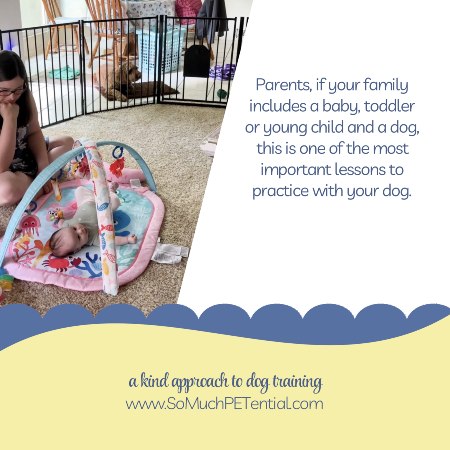
Parents, if your family includes a baby, toddler or young child and a dog, prevent problems with this important lesson to practice with your dog. Dog Success Stations (coined by my teacher/mentor Jen Shryock of Family Paws) prevent problem behaviors BEFORE those behaviors become a THING. Teaching your dog to settle on a mat behind a gate creates safety when there is a baby on the scene, allowing your dog to observe, gain familiarity and be included without pressure.
A success station is a management tool to prevent problems, a space where dogs and families can get their needs met for comfort, safety, and enrichment. This is very important as it allows a dog and baby, child or other species to observe, gain familiarity, and be included without pressure and unwanted direct interaction.
A success station goes a long way toward creating harmony and opening the path to connection.
What do I mean by potential problems? A problem could be your pet finding unwanted choices for fulfilling those needs; or it could be your young child or infant being an unwelcome intruder to your pet. Moving babies that like to reach and pull and crawl on top of what seems interesting, is often NOT how a dog would choose to have happen – especially if dog is in possession of a resource. Flipping it around, a young kiddo may not appreciate a curious dog barging in to steal toys or knocking over what is in a path.
Rapidly changing babies grow and begin moving in ways that can be scary to dogs. They will start crawling toward the family dog, grabbing for things (including your dog’s toys and fur), making strange noises. Their equipment too can be off putting to your dog, or get your dog too excited.
Any way you look at it, dogs and little kids should ALWAYS be actively supervised by an adult who knows what to watch for.
Without active supervision and a good management plan, you will find yourself responding in reaction to behaviors instead of proactively focusing on what you would rather have happen. There are SO many potential fall outs with that approach. Among them…you are allowing the problem behavior to be practiced (and reinforced), you could find yourself using a punishment, you are not teaching your pet what to do instead.
If a child is involved, that child may also learn negative associations with being near your dog (if your dog does something to scare your child) or may learn there is great value to move in and do something to your dog (because it could get your dog to chase or give up a toy, for example)
There are different ways of creating Success Stations for dogs.
A physical barrier such as a gate prevents access to trouble while also allowing you to train through it. Please see my video below for how I worked with parents on teaching their dog to settle on the other side of their gate. In some cases, you may want a double barrier to create a bigger buffer and not allow hands or noses to reach through and come face-to-face.
Plastic infant playpens or dog x-pens that come apart can allow for so many choices in management. You can:
- Give your dog activities inside the pen or give your child activities inside the pen
- Pull the pen panels across open floor plans to create barriers
- Put the pen panels around areas you want contained such as where kids’ toys are stored
- Put the panels in front of doorways to remove direct access
Other types of Success Stations can include:
- Putting your dog/puppy in a crate
- Putting your dog/puppy on an outside porch or in a fenced in yard
- Tethering your dog across the room (this is not a good idea when your home has mobile kids)
- Teaching your dog to settle on a bed (again, not a good idea in the presence of mobile infants)
Remember that, for many dogs, you may need to spend time teaching a positive association with whatever Success Station you use.