






Medically reviewed by Dr. Paula Simons, registered veterinarian
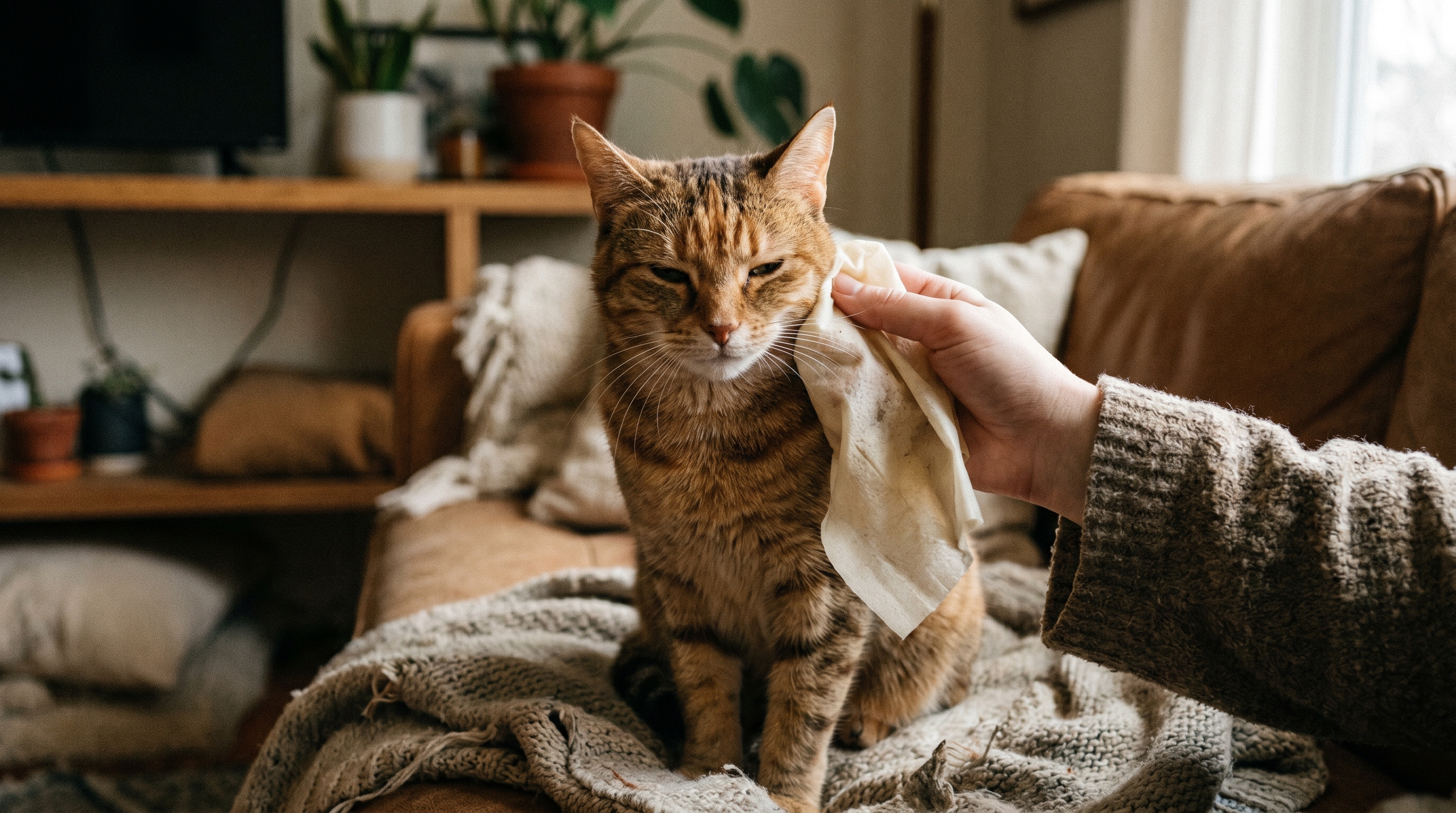
Cat wipes are pre-moistened cloths for spot-cleaning a cat’s coat, paws, ears, and facial folds without water. For between-bath maintenance, use a fragrance-free, alcohol-free formula reviewed for animal skin safety.
One Amazon reviewer put it plainly: “Seems to work well. One [*!^$ of a lot better than trying to bathe my cat in water!!” (Amazon, 2024). That’s the whole case for cat wipes in one sentence. Bathing a cat isn’t a grooming strategy. It’s optimism followed by regret, measured in scratch depth and the time it takes to find all the towels.
Wipes give you a way out of that standoff. GIVE A SH!T® pet wipes are made for both dogs and cats, with a formula Dr. Paula Simons reviewed for skin-contact safety on both species.
Cat wipes: when they make sense
Post-outdoor excursions are the clearest use case. If your cat goes outside, they pick up pollen, dust, and pesticide residue on their coat. They’ll groom most of it off themselves, which means they ingest it. A wipe-down when they come inside removes the bulk before it moves from coat to mouth.
Flat-faced breeds need more help than other cats. Persian, Himalayan, and Scottish Fold cats have compressed facial anatomy that creates skin folds under the eyes and around the nose. Those folds trap moisture and debris your cat can’t reach during normal grooming. Left alone, fold areas develop odor and, in some cats, mild skin irritation. A gentle daily wipe with a fragrance-free formula keeps fold areas clean without running water near their face.
Senior cats self-groom less as they age. Arthritis, reduced flexibility, and lower energy all contribute. A cat that once groomed fastidiously will start to develop dull, slightly greasy coat sections along the back and base of the tail. One Judge.me reviewer described exactly this: “My long-haired cat has a hard time cleaning her bottom completely. I use one of these wipes to get the bits she can’t. She really likes these wipes. She patiently lets me clean her.” (Judge.me, October 2024.) Wipes fill that gap without your cat having to do anything except tolerate two minutes of gentle attention.
General coat freshening is a fourth use case with no breed or age requirement. If your cat has been near a fireplace, on a dusty sofa, or in a room heavy with cooking odors, a quick wipe removes surface residue and brings their coat back to baseline.
Ingredient safety: what a cat-safe formula looks like
Cats lick themselves constantly.
Whatever a wipe leaves on your cat’s coat gets ingested within minutes. This is why the ingredient list matters more for cat wipes than for a surface cleaner or even a dog wipe. Cats are more thorough self-groomers and will work through every surface they can reach. Understanding what goes into a pet wipe formula is the starting point for picking one you can actually use daily.
Alcohol is the ingredient to check first and avoid. Isopropyl alcohol and ethanol dry the coat and skin with repeated contact. At the concentrations used in disinfecting products, they also present an ingestion concern for a cat that will groom immediately after being wiped. A formula designed for daily use on your cat should be alcohol-free.
Artificial fragrance is the second concern. Fragrance-free means fragrance-free, not lightly scented. Synthetic fragrance compounds are a common cause of contact dermatitis in both cats and dogs, and add fragrance molecules to the self-grooming ingestion cycle with every use.
Chlorhexidine appears in some grooming products at concentrations suited for wound care rather than daily coat contact. At those levels it can cause oral irritation in cats that groom after being wiped. A cat-safe formula uses it at low concentration or not at all.
Baby wipes fail this checklist for most cats. Many contain fragrance or preservatives appropriate for human infant skin, but they aren’t reviewed for a cat that’ll lick the product off within minutes. More on that in the comparison section below.
So: alcohol-free, fragrance-free, no high-dose chlorhexidine. That’s the filter.
GIVE A SH!T® wipes: how the formula holds up for cats
GIVE A SH!T® wipes were built for both dogs and cats. Dr. Paula Simons, the registered veterinarian who reviewed the formula, confirmed it’s safe for skin-contact use on both species.
The full ingredient list: Water, Aloe Vera, Shea Butter, Chamomile extract, Cucumber extract, Oat Extract, Vitamin E (Tocopherol Acetate), Nicotinamide (Vitamin B3), Glycerin, Tocopherol, Citric Acid, Sodium Citrate, Caprylyl Glycol, Caprylhydroxamic Acid, Decyl Glucoside, 1,3-Butylene Glycol, Gluconolactone, and Hydroxyacetophenone. No alcohol, no artificial fragrance, no parabens.
The wipes are made with VEOCEL™ fibers, which hold independent compostability certifications on the fiber substrate. (The full GIVE A SH!T® formulated wipes product isn’t separately certified as a whole product yet. That certification covers both the fiber and cleansing formula together and is currently in progress.) Each wipe is 8 × 8 inches, textured, and thick enough to lift mud, dander, and surface residue without tearing mid-wipe.
Real-world: “My cat loves these too and they don’t leave a weird smell on her after.” (Judge.me, August 2024.) And: “After using it on my cats daily, there is no irritation so far.” (Amazon, 2024.) The wipes are also PETA-certified cruelty-free.
Yes, that’s a long ingredient list. We don’t love reading them either. The short version: plant-based base, no irritants, reviewed specifically for cats.
Cat wipes vs. baby wipes: why the label matters
The most common shortcut when you’re out of pet wipes is a baby wipe. The logic makes sense on the surface: baby wipes are gentle, fragrance-free options exist, and they’re usually already in the house.
The gap is design criteria. “Gentle for a human infant’s skin” and “safe for a cat that will lick this off within 90 seconds” aren’t the same standard. Baby wipes aren’t formulated with oral safety in mind. Cat-specific wipes with a vet-reviewed formula are.
| Feature | 🐱 GIVE A SH!T® wipes | Baby wipes (typical) |
|---|---|---|
| Alcohol-free | ✅ Yes | Varies by brand |
| Fragrance-free | ✅ Yes | Some, not all |
| Formula reviewed for lick-safety | ✅ Dr. Paula Simons (DVM) | ❌ Not designed for |
| Plant-based fiber | ✅ VEOCEL™ Lyocell | Varies by brand |
| Hypoallergenic | ✅ Yes | Varies by brand |
| Reviewed for cats and dogs | ✅ Both species | ❌ Not tested for |
Buying in bulk: the 400 and 600 packs
If you have more than one cat, a long-haired breed that needs regular wipe-downs, or a senior cat you’re spot-cleaning daily, the 100-pack runs out faster than you’d expect.
GIVE A SH!T® wipes come in 100, 200, 400, and 600 packs. The 400 and 600 packs carry significant per-wipe savings over the 100-pack price and make sense if wipes are a daily routine rather than an occasional grab. No poop bags added in, no dispensers, just wipes. If you’re going through them quickly, it’s worth looking at the larger options before reordering the 100-pack a third time.
All pack sizes are available on a one-time or subscribe-and-save basis. First subscription order saves 15% off the one-time price; recurring orders save 10%. Most cat owners on a regular wipe routine find a monthly or bi-monthly cadence fits without stockpiling.
Cat wipes: frequently asked questions
Can I use dog wipes on my cat?
Yes, if the formula is reviewed for both species. A wipe designed for dogs but not formulated with feline self-grooming safety in mind may include ingredients inappropriate for a cat that will lick it off immediately. GIVE A SH!T® wipes are specifically reviewed for use on both cats and dogs by Dr. Paula Simons (DVM).
How often should I use cat wipes?
For most cats, a wipe after outdoor excursions and a general coat wipe every week or two is enough. Flat-faced breeds with facial fold buildup may need a daily wipe on the affected areas. Senior cats that self-groom less may need more frequent attention, particularly along the back and base of the tail.
Are baby wipes safe for cats?
Most baby wipes aren’t formulated with feline lick-safety in mind. Some contain fragrance or preservatives that aren’t reviewed for regular oral exposure. Cat-specific wipes with a vet-reviewed formula are the safer default, even for a quick one-off clean.
Can I use wipes on a kitten?
The GIVE A SH!T® formula is reviewed as safe for cats, but check with your vet for kittens under eight weeks. Very young kittens are typically small enough that a warm damp cloth is sufficient and lower-stakes than any wipe product.
Do cat wipes remove allergens from fur?
Wipes remove surface dander, dust, and debris from the coat. They don’t eliminate Fel d 1 (the primary cat allergen) from your home environment, since that protein is also present in saliva and skin cells shed throughout the room. Regular wipe-downs reduce what’s on the coat. They’re part of an allergen-management routine, not a complete solution on their own.
My cat hates being touched. Any tips?
Start with the areas your cat tolerates best, usually the head and shoulders. Keep sessions short: one pass on each side, done. A wipe that’s been run under warm water for 20 seconds (then squeezed out) feels closer to normal grooming than a cold surprise. If your cat bolts after one pass, that’s still a better outcome than the bath war. One pass takes 30 seconds.