

As an Amazon Associate I earn from qualifying purchases. Learn More
Updated August 2026
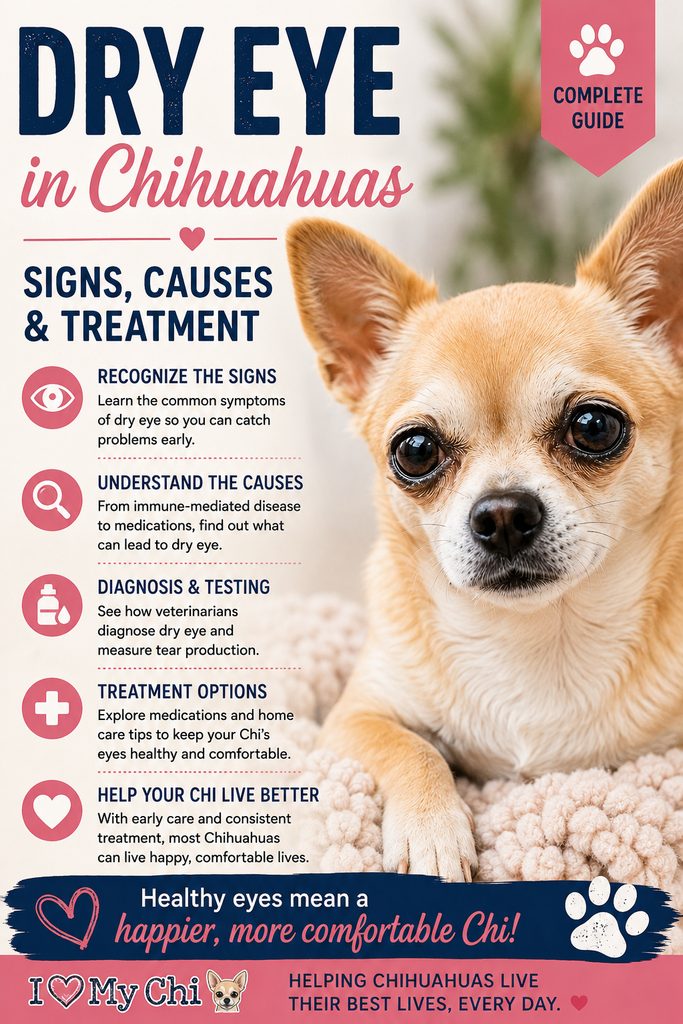
Those big, expressive eyes are one of the things we love most about our Chihuahuas. Unfortunately, their eyes can also develop a variety of problems, including a condition called keratoconjunctivitis sicca (KCS)—better known as dry eye.
Dry eye may sound like a minor annoyance, but it can actually be quite uncomfortable for a dog. Without treatment, it can lead to inflammation, corneal ulcers, scarring, and even vision loss.
Fortunately, KCS is usually very manageable when it’s diagnosed early and treated consistently.
Quick Answer: What Is Dry Eye in Dogs?
Keratoconjunctivitis sicca (KCS), commonly called dry eye, occurs when a dog’s eyes don’t produce enough tears or when the tear film doesn’t adequately protect the surface of the eye.
Common signs include red or irritated eyes, thick or sticky discharge, frequent blinking, squinting, and rubbing at the eyes.
Most dogs with KCS require ongoing treatment, but with proper veterinary care, they can remain comfortable and maintain good vision.
What Is Keratoconjunctivitis Sicca?
Your dog’s tears do much more than make their eyes look shiny.
Tears help lubricate and nourish the cornea, wash away debris, and protect the eye from infection.
The tear film that covers the eye is made up of several components, including water, mucus, and oils. If your dog doesn’t produce enough of the watery portion of tears—or if the tear film isn’t functioning properly—the surface of the eye can become dry and inflamed.
Most cases of KCS in dogs involve inadequate tear production, although some dogs produce a normal quantity of tears but have poor tear quality.
Either way, the result is an eye that isn’t getting the moisture and protection it needs.
Signs of Dry Eye in Dogs
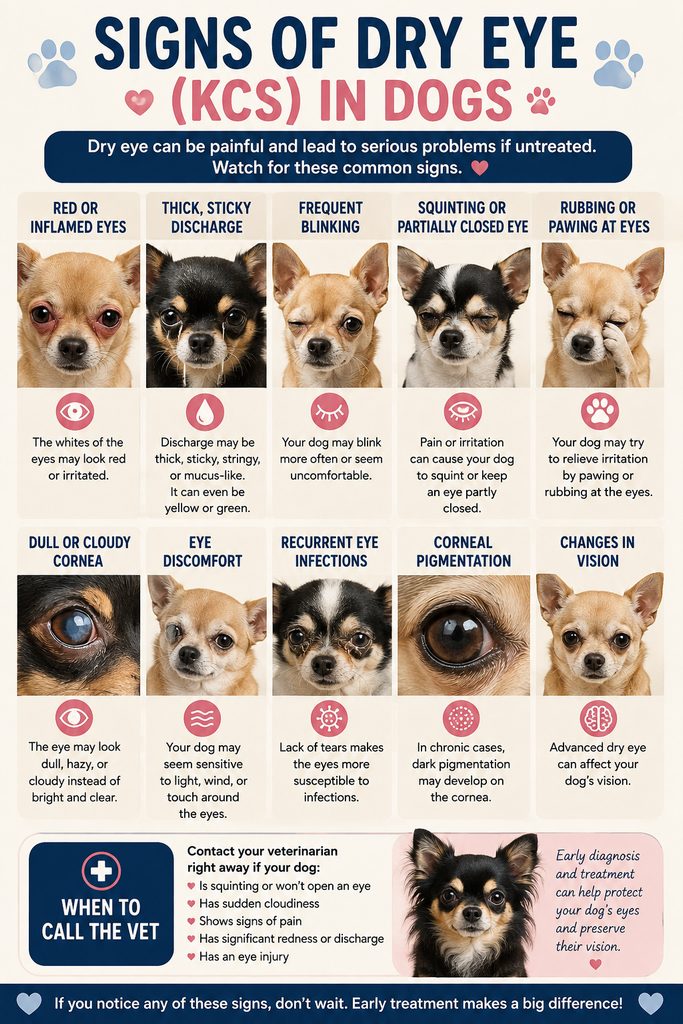
Dry eye doesn’t always look like a “dry” eye. In fact, one of the most noticeable symptoms can be a thick discharge.
Signs of KCS can include:
- Red or inflamed eyes
- Thick, sticky, stringy, or mucus-like eye discharge
- Yellow or greenish discharge
- Frequent blinking
- Squinting or holding an eye partially closed
- Rubbing or pawing at the eyes
- Dull-looking eyes
- Cloudiness of the cornea
- Sensitivity around the eyes
- Recurrent eye infections
- Dark pigmentation developing over the cornea
- Changes in vision in advanced cases
Because yellow or green discharge is often associated with infection, it’s easy to assume your dog simply has conjunctivitis. However, inadequate tears make the eye more susceptible to secondary infections, so KCS may actually be the underlying problem.
When Should You Call the Vet?
Eye problems can become serious surprisingly quickly.
Contact your veterinarian promptly if your Chihuahua is squinting, refusing to open an eye, repeatedly rubbing at an eye, or has significant redness, sudden cloudiness, an injury, or other signs of eye pain.
A painful or squinting eye shouldn’t be treated at home without first determining what’s causing it.
Dry eye can lead to corneal ulcers, which are painful sores on the surface of the eye. An infected corneal ulcer can become an emergency and, in severe cases, may threaten the eye itself.
What Causes Dry Eye in Dogs?
There are several possible causes of KCS.
Immune-Mediated Disease
The most common cause of dry eye in dogs is an abnormal immune response that attacks and damages the glands responsible for producing tears.
As those glands become damaged, they produce fewer tears.
This type of KCS generally requires lifelong treatment.
Certain Medications
Some medications can interfere with tear production. Sulfonamide (“sulfa”) medications are one example associated with KCS in some dogs.
Never discontinue a prescribed medication without talking with your veterinarian, but let your vet know about everything your dog is currently taking if dry eye develops.
Canine Distemper
Canine distemper virus can damage tear-producing glands and cause KCS. Fortunately, vaccination has made distemper much less common among properly vaccinated dogs.
Neurological Problems
Damage to the nerves responsible for stimulating tear production can cause a form known as neurogenic KCS.
This may affect only one eye. In some cases, the nostril on the same side of the dog’s face may also appear unusually dry.
Endocrine Diseases
Certain endocrine conditions, including hypothyroidism, have been associated with decreased tear production in some dogs.
Congenital Problems
Rarely, a dog may be born with poorly developed or absent tear glands.
Trauma or Radiation
Injury affecting the tear glands or nerves around the eye can interfere with tear production. Radiation treatment near the eye may also damage tear-producing tissue.
Problems With the Third Eyelid Gland
Dogs have a tear-producing gland associated with their third eyelid.
This is one reason veterinarians generally try to preserve and reposition the gland when treating cherry eye rather than simply removing it. Removal of the gland can increase the risk of developing dry eye later.
Are Chihuahuas Prone to Dry Eye?
Chihuahuas aren’t generally considered one of the breeds at highest genetic risk for KCS, but any Chihuahua can develop dry eye.
Some breeds are diagnosed with KCS more frequently, including:
- Cavalier King Charles Spaniels
- English Bulldogs
- Lhasa Apsos
- Pugs
- Shih Tzus
- West Highland White Terriers
Regardless of breed, changes in your dog’s eyes shouldn’t be ignored.
Chihuahuas already have large, prominent eyes, so it’s especially important to pay attention to redness, discharge, squinting, cloudiness, or other changes.
How Is Dry Eye Diagnosed?
You can’t reliably diagnose KCS just by looking at your dog’s eyes.
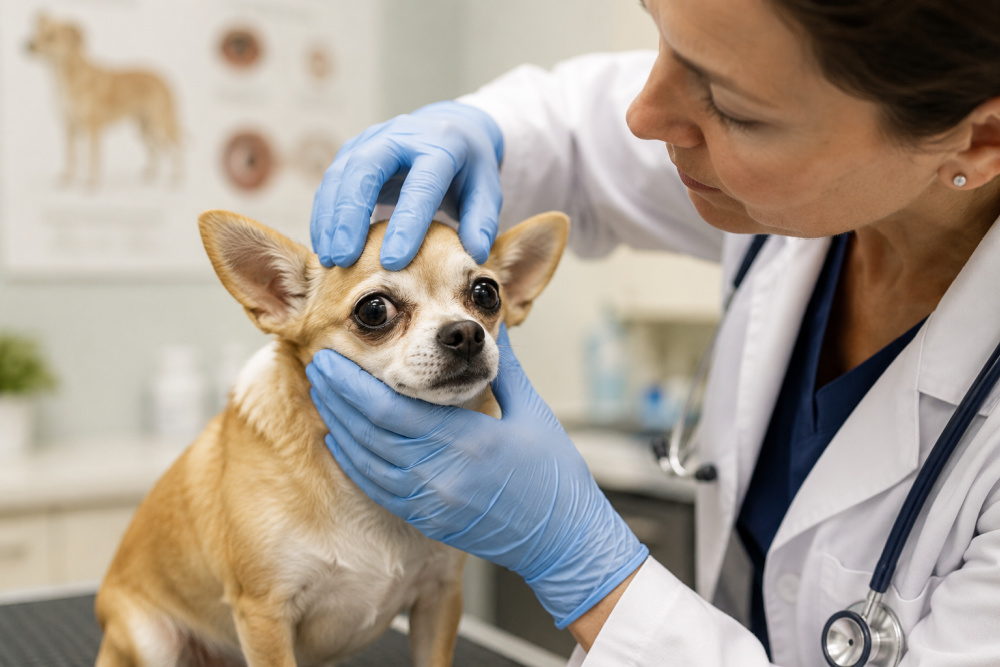
Your veterinarian will examine the eye and may perform several simple tests.
The Schirmer Tear Test
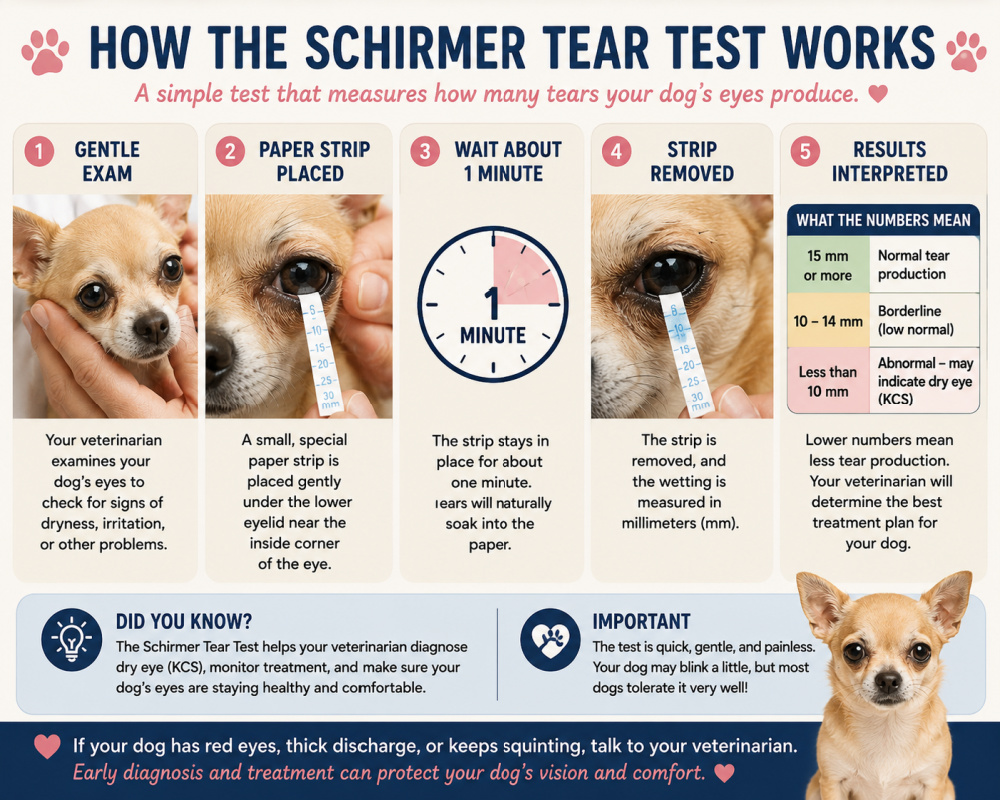
One of the most common tests is the Schirmer Tear Test (STT).
Don’t be alarmed if you see your veterinarian put a tiny strip of paper underneath your Chihuahua’s eyelid. This little strip measures how many tears the eye produces over approximately one minute.
The tears travel up the paper, allowing the veterinarian to measure tear production.
It’s a simple test that provides valuable information about how well your dog’s tear glands are functioning.
Fluorescein Stain
Your veterinarian may also place a special dye called fluorescein on the eye.
This helps reveal scratches and corneal ulcers that might otherwise be difficult to see.
Additional Eye Tests
Sometimes a dog has symptoms of dry eye even though the Schirmer Tear Test shows an adequate quantity of tears.
In these cases, a veterinary ophthalmologist may perform additional testing to evaluate the quality and stability of the tear film.
How Is Dry Eye in Dogs Treated?
Treatment depends on the cause and severity of your dog’s KCS, but there are generally two important goals:
- Stimulate your dog’s natural tear production whenever possible.
- Keep the surface of the eye properly lubricated and protected.
Medications That Stimulate Tear Production
Two medications commonly used to treat immune-mediated KCS are cyclosporine and tacrolimus.
These medications help reduce inflammation within the tear-producing glands and encourage the glands to produce more natural tears.
They aren’t instant fixes.
It may take several weeks before their full effects are seen, so don’t assume a medication isn’t working because your dog’s eyes don’t improve immediately.
Always give eye medication according to your veterinarian’s instructions.
Artificial Tears and Lubricants
Your veterinarian may recommend lubricating eye drops, gels, or ointments to keep the cornea moist, particularly while medications that stimulate tear production are beginning to work.
Some dogs continue to benefit from additional lubrication long-term.
Treating Secondary Problems
If your Chihuahua has developed a secondary bacterial infection or corneal ulcer, additional medications may be needed.
The exact treatment will depend on what’s happening in the eye.
This is also why it’s important not to use leftover prescription eye medication from a previous eye problem or from another pet.
Some eye medications, particularly those containing corticosteroids, can be inappropriate or harmful when a corneal ulcer is present.
Will My Dog Need Eye Medication Forever?
Possibly—and in many cases, yes.
The most common form of canine KCS is usually a chronic condition rather than something that is permanently cured.
Once your Chihuahua’s eyes look normal again, it can be tempting to think the problem has disappeared and stop the medication. Unfortunately, the improvement may simply mean the treatment is doing its job.
Stopping medication can allow dry eye to return.
Your veterinarian will monitor your dog’s tear production and determine whether treatment needs to be adjusted.
Caring for a Chihuahua With Dry Eye at Home
Once you get into a routine, caring for a dog with KCS is usually quite manageable.
A few things can help:
- Give all eye medications according to schedule.
- Keep follow-up veterinary appointments.
- Watch for increased redness, discharge, squinting, or rubbing.
- Keep the hair around your Chihuahua’s eyes clean and trimmed if necessary.
- Gently remove accumulated discharge with a clean, soft cloth moistened with warm water.
- Wash your hands before and after applying eye medication.
- Don’t allow the tip of an eye-drop bottle or ointment tube to touch your dog’s eye.
- Contact your veterinarian if the eye suddenly looks worse.
And perhaps most importantly:
Don’t put human eye medications, leftover prescriptions, herbal preparations, or home remedies into your dog’s eyes unless your veterinarian specifically approves them.
An eye that looks irritated could have KCS, an ulcer, an injury, glaucoma, infection, or another condition that requires a completely different treatment.
What Happens If Dry Eye Isn’t Treated?
Untreated KCS can become much more serious than an uncomfortable dry eye.
Without an adequate tear film, the cornea loses some of its natural protection. Over time, this can result in:
- Chronic inflammation
- Recurrent infections
- Corneal ulcers
- Blood vessel growth across the cornea
- Corneal scarring
- Dark pigmentation covering the cornea
- Vision impairment
- Blindness
Severe corneal ulceration with infection can even result in loss of the eye.
The good news is that these complications can often be avoided when dry eye is caught and treated early.
What If Medication Doesn’t Work?
Most dogs respond well to medical treatment.
However, if your Chihuahua’s eyes aren’t producing enough tears despite treatment, your regular veterinarian may recommend seeing a board-certified veterinary ophthalmologist.
Severe cases that don’t respond adequately to medication may occasionally be treated surgically.
One procedure, called parotid duct transposition, redirects a salivary duct so that saliva helps provide moisture to the surface of the eye.
Surgery isn’t necessary for most dogs with KCS, but it can be an option when medical management isn’t providing enough relief.
What Is the Prognosis for a Dog With Dry Eye?
The prognosis for most dogs with KCS is very good when the condition is diagnosed early and treatment is given consistently.
Your Chihuahua may need medication for the rest of his or her life, but that’s a small price to pay for comfortable eyes and preserved vision.
Regular veterinary rechecks are important because your dog’s tear production can change over time. Your veterinarian may periodically repeat the Schirmer Tear Test and adjust medications if necessary.
Frequently Asked Questions About Dry Eye in Dogs
Is dry eye painful for dogs?
Yes. A dry ocular surface can be quite uncomfortable and may cause burning, irritation, squinting, or rubbing. Corneal ulcers caused by severe dry eye can be particularly painful.
Can dry eye make a dog go blind?
Severe, untreated KCS can eventually impair vision. Chronic inflammation may cause scarring, blood vessel growth, and dark pigmentation across the cornea. Corneal ulcers can also cause serious complications.
Early diagnosis and consistent treatment greatly reduce these risks.
Can a dog have dry eye in only one eye?
Yes. Although the common immune-mediated form frequently affects both eyes, certain types of KCS—particularly those involving nerve damage—may affect only one eye.
Is dry eye contagious?
KCS itself isn’t contagious. However, certain infectious diseases can occasionally contribute to its development.
Can I use human artificial tears on my Chihuahua?
Don’t use a human eye product unless your veterinarian has specifically approved it for your dog.
Some lubricating products used for humans may also be recommended for dogs, but formulations and ingredients vary. More importantly, you need to know why your dog’s eye is irritated before treating it.
Does dry eye ever go away?
It depends on the underlying cause, but the most common immune-mediated form of KCS usually requires lifelong management.
Fortunately, most dogs respond well to treatment.
How often should my dog be rechecked?
Your veterinarian will determine the appropriate schedule based on the severity of your Chihuahua’s condition and response to treatment.
Early in treatment, more frequent rechecks may be necessary. Once KCS is well controlled, your veterinarian may recommend periodic monitoring to make sure tear production remains adequate.
Final Thoughts
Dry eye may not sound particularly serious, but your Chihuahua’s tears play an essential role in keeping those beautiful eyes healthy.
If you notice thick discharge, redness, squinting, cloudiness, or frequent eye rubbing, don’t assume it’s simply an allergy or minor irritation. Have your veterinarian take a look.
Keratoconjunctivitis sicca is usually very manageable, especially when it’s caught early. With the right medication, regular monitoring, and a little extra eye care at home, most dogs with KCS can remain comfortable and enjoy good vision for years to come.
What is Keratoconjunctivitis Sicca?
Keratoconjunctivitis Sicca is a medical term for Dry-Eye Syndrome. To the untrained eye, the eye shows symptoms of trying to expel some debris that may have blown into the eye, but eyes suffering from Dry Eye Syndrome are not just red and cloudy because they are trying to wash away some foreign object. The eye looks that way because it is no longer producing a sufficient amount of tears to protect the eye.
Unlike a simple eye rinse, if the suffering eye is not medically treated, the eye can become infected and worse.
Is It Normal For Dogs to Suffer From Dry-Eye Syndrome?
While human beings can suffer from this issue, dogs, cats, and other animals can contract it, as well.
In fact, some breeds of dogs seem to be more prone to suffer from it than others.
The dogs that top the list are: Shih Tzus, Samoyeds, Pugs, Pekingese, Lhasa apsos, English bulldogs, Bloodhounds, some of the Spaniel breeds, and many of the Terrier breeds to name just a few.
So, what are some of the causes of lowered tear production which lead to Dry-Eye Syndrome in dogs?
While there are many causes, some of the more common are
- Your dog developing an allergy
- Hypothyroidism
- Canine Distemper
- An immune-mediated disease that damages the tear-producing gland.
Because several of these causes have to do with your dog’s internal health, it is highly recommended that you let your dog’s health care professional perform a complete evaluation to determine the exact cause so that a relapse of the condition is minimized.
So, now that you know what the problem is, how is it treated?
Technically, the cure for Dry-Eye has two parts which your Vet will be correcting at the same time. The treatment course is to
- Get tear production back up to normal level
- Regenerate the “tear film” which is a lubricating layer of tears that coats all healthy eyes which the normal production of tears helps maintain.
Think of it like this—the engine in your car is your dog’s eye, and the oil in your car is your dog’s tears. The oil’s job is to keep the engine nice and lubricated so that it doesn’t get damaged. If for some reason the oil stops coating the engine, the engine is in bad trouble. It’s a similar relationship with your dog’s tears and eyes. (As well as in your own eyes.)
At the time of this writing, the two most commonly used medications to resume natural tear production Vets use are cyclosporine and tacrolimus.
These drugs are very safe and easy to place into the dog’s eye. While this application is usually done once or twice a day your dog’s Vet will provide you with detailed instructions on how best to administer the medication to your dog.
In addition to the above medications, your Vet may also prescribe an antibiotic and/or an anti-inflammatory regimen to fight and/or protect the eye from infection while the “tear film” is being regenerated.
If you want to help even more, and your Vet agrees, you can also assist with your dog’s healing by gently washing your dog’s eye several times a day with a warm, wet, washcloth.
But don’t forget–the word is “gently”.
For most of us, our dogs aren’t just pets, they’re family members, so by following your Vet’s directions and utilizing the loving care you know so well, it won’t be long before your four-legged family member is once again, both Bright-Eyed and Bushy-Tailed.
This means that the next time you are in a mood for one of those old sentimental movies, there won’t be any Dry-Eye’s in the house.
Be sure to check out other chihuahua health problems too!



Pet Blogger
I have had dogs all my life. I have been a pet groomer, worked in a pet hotel, and a kennel, and have bred and showed dogs.
Dr. Sara Ochoa
DVM
This article has been fact-checked and approved by Dr. Sara Ochoa DVM. You can read more about her on our About page.
Post Views: 4,842