

As an Amazon Associate I earn from qualifying purchases. Learn More
I remember sitting in my home office and watching my fluffy white terri-poo Joey stand up. The little lump that I had felt on his back leg a few days earlier was suddenly huge!
How did that happen in just a few days?
What was even worse was that there were some spots of blood on his dog bed. I checked the lump and realized it had cracked open. I’m not sure if Joey had been scratching at it or if it opened because it had grown so big so quickly, but there was a foul odor coming from it.
I immediately got him in to see my veterinarian, who suspected cancer. Even if it wasn’t cancer, the mass needed to be removed as quickly as possible to avoid infection, so Joey had surgery the next day.
Unfortunately, it was cancer—and a fast-growing kind.
Fortunately, it was isolated and hadn’t spread to his other organs, so Joey didn’t need chemotherapy or radiation.
He was 13 years old when this happened. My vet warned me that the cancer would probably come back, but it never did.
Joey lived almost another six years.
I share Joey’s story because cancer is a frightening word for any dog parent to hear. But a cancer diagnosis doesn’t always mean you’re about to lose your dog. Some cancers can be successfully treated, and finding them before they have had a chance to spread can sometimes make a big difference.
That’s also why it’s important to know what changes to watch for in your Chihuahua.
Cancer in Chihuahuas
Cancer occurs when abnormal cells begin growing uncontrollably. These cells may form a tumor, invade surrounding tissues, or spread to other areas of the body.
Cancer becomes more common as dogs age, although dogs of any age can develop it.
Chihuahuas can develop many of the same cancers that affect other breeds, including:
- Mast cell tumors
- Lymphoma
- Mammary tumors
- Melanoma and other oral cancers
- Soft tissue sarcomas
- Hemangiosarcoma
- Bone cancer
Some cancers are more strongly associated with particular breeds and sizes than others. For example, osteosarcoma (bone cancer) occurs much more frequently in large and giant breeds than it does in tiny breeds such as Chihuahuas.
There isn’t one particular cancer that every Chihuahua owner should be constantly watching for. What’s more important is knowing your own dog and noticing when something changes.
Important: These Signs Don’t Automatically Mean Cancer
Before we get into the warning signs, I want to emphasize this:
Having one—or even several—of these symptoms does NOT mean your Chihuahua has cancer.
Many common health conditions can cause exactly the same symptoms. Dental disease can cause terrible breath and difficulty eating. An infection can enlarge lymph nodes. Arthritis can cause limping. Gastrointestinal problems can cause vomiting, diarrhea, weight loss, and appetite changes.
These are signs that something may be wrong and that your veterinarian should investigate—not a way to diagnose cancer at home.
And if you’re anything like me, getting your dog checked is better than spending the next week worrying and imagining the worst!
The American Veterinary Medical Association also emphasizes that these signs can have many causes and that a veterinary examination and diagnostic testing are needed to determine what’s actually wrong.
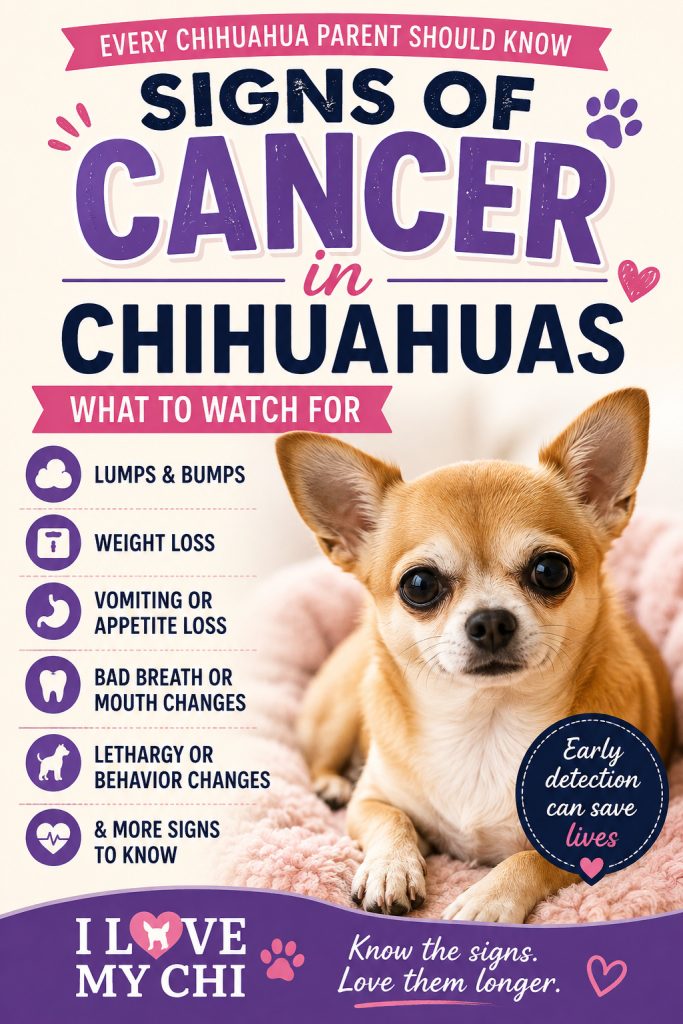
13 Possible Signs of Cancer in Chihuahuas
1. New or Changing Lumps and Bumps
Finding a lump on your Chihuahua can be scary, but don’t immediately assume it’s cancer.
Dogs commonly develop benign (non-cancerous) growths as they get older, including lipomas and sebaceous growths.
The problem is that you can’t reliably tell whether a lump is harmless just by looking at it or feeling it.
Some cancerous tumors can look and feel very similar to benign growths. Mast cell tumors, for example, can sometimes resemble harmless fatty lumps.
These warning signs are based on symptoms veterinary oncologists commonly associate with cancer and other serious illnesses in dogs. Cornell University College of Veterinary Medicine lists changes such as unusual lumps, weight loss, persistent lameness, abnormal bleeding, and difficulty eating, breathing, urinating, or defecating among signs that deserve veterinary attention.
Have your veterinarian examine any new lump, particularly one that:
- Grows rapidly
- Changes shape, color, or texture
- Becomes irritated
- Bleeds or develops discharge
- Breaks open
- Seems painful
- Disappears and then returns
Joey’s tumor is a perfect example. The speed at which that little lump changed was what immediately told me something wasn’t right.
2. A Sore That Won’t Heal
A cut or minor skin irritation should gradually improve.
A sore that repeatedly bleeds, crusts over, opens again, develops discharge, or simply refuses to heal deserves a veterinary examination.
There are plenty of non-cancerous reasons for persistent sores, including infection, allergies, and constant licking or scratching, but certain skin cancers can also cause lesions that don’t heal normally.
3. Unexplained Weight Loss or Loss of Appetite
Most of us Chihuahua parents know exactly how interested our dogs normally are in dinner!
A noticeable decrease in appetite or unexplained weight loss should get your attention, particularly if it continues.
Cancer can sometimes affect appetite, digestion, metabolism, or the body’s ability to use nutrients. However, many other illnesses can cause the same symptoms.
If your Chihuahua is losing weight without a change in diet or exercise, talk with your veterinarian.
4. A Swollen or Enlarged Abdomen
A gradually enlarging belly—or especially an abdomen that suddenly becomes swollen—can have many possible causes.
In some cases, tumors in the abdomen can become quite large before they’re noticeable from the outside.
A suddenly swollen abdomen accompanied by weakness, pale gums, rapid breathing, or collapse is an emergency and requires immediate veterinary care.
5. Enlarged Lymph Nodes
Lymph nodes are part of your Chihuahua’s immune system and are located in several areas of the body, including under the jaw, near the shoulders, behind the knees, and in the groin.
They can become enlarged because of infection, inflammation, immune-system problems, or cancers such as lymphoma.
You may notice firm swellings beneath your dog’s jaw or in other areas where lymph nodes are located.
Don’t panic if you feel one, but do have your veterinarian check it.
6. Unexplained Bleeding, Discharge, or Bruising
Unusual bleeding or discharge from the mouth, nose, urinary tract, rectum, or other body opening should be investigated.
Unexplained bruising is also worth mentioning to your veterinarian.
There are many possible causes besides cancer, but bleeding can sometimes occur because of a tumor or because an illness is affecting the blood’s ability to clot.
7. Pale Gums
Your Chihuahua’s gums should normally be a healthy pink unless your dog naturally has dark pigmentation in the mouth.
Very pale, gray, or white gums can be a sign of anemia, blood loss, poor circulation, or another serious medical problem.
Internal bleeding from a ruptured tumor is one possible cause.
If pale gums occur along with weakness, collapse, difficulty breathing, or a swollen abdomen, seek emergency veterinary care immediately.
8. Difficulty Eating or Swallowing
Watch for changes such as:
- Dropping food
- Chewing only on one side
- Reluctance to eat hard food
- Difficulty swallowing
- Excessive drooling
- Pawing at the mouth
- Bleeding from the mouth
Dental disease is extremely common in Chihuahuas and is a much more common explanation for many of these symptoms.
However, tumors can also develop in the mouth, gums, tongue, jaw, and throat.
Because Chihuahua dental problems are so common, it’s especially easy to assume a mouth problem is “just their teeth.” Persistent or unusual changes deserve an examination.
9. Persistent Bad Breath or Other Unusual Odors
Anyone who has lived with a Chihuahua knows that bad breath isn’t exactly unusual for this breed!
Most bad breath is caused by dental disease, but an unusually strong or foul odor from the mouth can occasionally accompany an oral tumor, infection, or damaged tissue.
Unusual odors can also come from infected or ulcerated skin masses—as I discovered with Joey.
If something smells distinctly different from your dog’s normal brand of stinkiness, it’s worth investigating.
10. Ongoing Vomiting, Diarrhea, or Changes in Bathroom Habits
An occasional upset stomach happens to most dogs.
Persistent vomiting or diarrhea is different.
Also pay attention to:
- Difficulty urinating
- Difficulty having a bowel movement
- Straining
- Blood in urine or stool
- Needing to urinate much more frequently
- Significant changes in stool
Cancer isn’t the most likely explanation for every digestive or bathroom problem, but tumors affecting the gastrointestinal or urinary systems can cause these symptoms.
Persistent changes should always be discussed with your veterinarian.
11. Persistent Limping, Stiffness, or Pain
Chihuahuas can limp for many reasons, including arthritis, luxating patellas, injuries, and back problems.
But unexplained lameness or pain that doesn’t improve—or continues getting worse—needs veterinary attention.
Cancer involving bones, joints, nerves, or surrounding tissues can sometimes cause persistent pain or lameness.
Don’t assume a senior Chihuahua’s stiffness or reluctance to move is automatically “just old age.”
12. Coughing or Difficulty Breathing
A persistent cough, rapid breathing, labored breathing, or reduced ability to exercise can have many causes, including heart and respiratory disease.
Cancer originating in the lungs or cancer that has spread to the lungs can also cause respiratory symptoms.
Any Chihuahua who is struggling to breathe needs prompt veterinary attention, regardless of the cause.
13. Unusual Fatigue, Weakness, or Behavior Changes
You know what’s normal for your Chihuahua better than anyone.
Maybe your normally energetic little shadow suddenly doesn’t want to follow you from room to room. Maybe she doesn’t want to go for her walk. Perhaps she’s sleeping much more, hiding, becoming unusually irritable, or just doesn’t seem like herself.
Cancer can cause lethargy and loss of stamina, but so can dozens of other health problems.
A persistent personality, activity, or energy change is worth mentioning to your veterinarian.
When Should You Call the Vet?
You don’t need to rush to an emergency hospital every time your Chihuahua develops a bump or skips breakfast.
But make an appointment with your veterinarian when you notice a new or unexplained change that persists, worsens, or simply concerns you.
Some symptoms do require urgent veterinary attention, including:
- Difficulty breathing
- Collapse
- Sudden extreme weakness
- Very pale, gray, or white gums
- A suddenly enlarged or painful abdomen
- Significant or uncontrolled bleeding
These symptoms can indicate internal bleeding or another life-threatening condition and shouldn’t wait for a regular appointment.
How Will I Know If My Chihuahua Has Cancer?
Unfortunately, symptoms alone can’t tell you.
If your veterinarian is concerned about cancer, the diagnostic process may include:
Physical Examination
Your veterinarian will examine your Chihuahua from nose to tail, feeling for abnormal masses or enlarged lymph nodes and checking the mouth, skin, abdomen, heart, lungs, and other areas.
Bloodwork and Urinalysis
Blood and urine tests can provide valuable information about your dog’s overall health, organ function, red and white blood cells, and other abnormalities.
However, it’s important to understand that normal routine bloodwork doesn’t rule out cancer.
Many dogs with cancer can have relatively normal bloodwork, particularly early in the disease.
X-Rays
X-rays may be used to look for tumors, examine bones, or determine whether a known cancer may have spread to the lungs or other areas.
Ultrasound
An abdominal ultrasound allows a veterinarian to examine internal organs and look for abnormal masses or enlarged lymph nodes.
CT or MRI
More advanced imaging may be recommended for certain tumors, particularly when the veterinarian needs to determine the exact size and location of a tumor or plan surgery or radiation treatment.
Fine-Needle Aspirate vs. Biopsy
If your Chihuahua has a suspicious lump or mass, your veterinarian may recommend sampling it.
A fine-needle aspirate involves inserting a small needle into the lump and collecting cells that can be examined under a microscope.
It’s often quick and minimally invasive and can provide useful information about many types of lumps.
A biopsy removes a piece—or sometimes all—of the abnormal tissue so a pathologist can examine the tissue more thoroughly.
The type of testing recommended will depend on where the mass is located and what your veterinarian suspects it might be.
This is another reason not to simply have every lump removed without discussing diagnostic options first. Knowing what kind of tumor you’re dealing with can sometimes help the surgeon plan how much surrounding tissue needs to be removed.
What Do Grade and Stage Mean?
If your Chihuahua is diagnosed with cancer, you may suddenly hear a whole new vocabulary.
Two terms you’ll probably encounter are grade and stage.
Cancer Grade
The grade describes characteristics of the cancer cells when examined under a microscope and can help veterinarians estimate how aggressively a particular tumor may behave.
Cancer Stage
The stage generally describes how extensive the cancer is—such as the size and location of the primary tumor, whether nearby lymph nodes are involved, and whether cancer has spread to other parts of the body.
The exact meaning of grades and stages varies depending on the type of cancer.
Staging may require additional tests such as X-rays, ultrasound, CT scans, or samples from nearby lymph nodes.
Can Cancer in Chihuahuas Be Treated?
Yes. Many cancers in dogs can be treated, although the outlook varies tremendously depending on the type of cancer, its location, its grade, and whether it has spread.
Treatment may include:
- Surgery
- Chemotherapy
- Radiation therapy
- Targeted or other cancer-specific medications
- Pain management and palliative care
- A combination of treatments
For some tumors, surgery alone may be all that’s necessary.
That’s what happened with Joey.
Other cancers require ongoing treatment. Unfortunately, some cancers can’t be cured, but treatment may still slow the disease or help a dog remain comfortable and enjoy a good quality of life.
What Is a Veterinary Oncologist?
A veterinary oncologist is a veterinarian who has completed advanced training in diagnosing and treating cancer in animals.
Your regular veterinarian may recommend an oncologist if your Chihuahua is diagnosed with cancer, particularly if the cancer is complicated or chemotherapy, radiation, or specialized treatment is being considered.
Seeing an oncologist doesn’t mean you’re committing to aggressive treatment.
A consultation can simply help you understand:
- Exactly what type of cancer your Chihuahua has
- Whether it has spread
- Available treatment options
- Expected side effects
- Prognosis with and without treatment
- Expected costs
- How treatment may affect your dog’s quality of life
You can then decide what makes the most sense for your Chihuahua and your family.
Is Chemotherapy Hard on Dogs?
This is one of the first concerns many people have because most of us associate chemotherapy with the difficult side effects humans can experience.
Veterinary chemotherapy is generally approached somewhat differently.
One of the major goals of cancer treatment in pets is maintaining good quality of life. Veterinarians don’t want a dog spending whatever time he has feeling miserable from treatment.
Dogs can still experience side effects from chemotherapy, including nausea, decreased appetite, vomiting, diarrhea, and changes in blood-cell counts. However, treatment can often be adjusted if side effects become significant.
Before deciding for or against chemotherapy, talk with your veterinarian or veterinary oncologist about what you can realistically expect with your Chihuahua’s particular cancer and treatment plan.
Are All Tumors Cancerous?
No!
This is important to remember when you discover a lump on your Chihuahua.
A tumor or mass can be benign, meaning it isn’t cancerous, or malignant, meaning it is cancerous and may invade surrounding tissues or spread elsewhere.
Older dogs commonly develop benign lumps and growths.
But since you can’t reliably determine what a lump is by looking at or feeling it, let your veterinarian make that determination.
Can Cancer in Chihuahuas Be Prevented?
Unfortunately, there is no way to prevent every cancer.
In fact, veterinarians don’t know exactly why many cancers develop in dogs.
So please don’t blame yourself if your Chihuahua develops cancer. It doesn’t mean you fed the wrong food, missed a supplement, didn’t exercise your dog enough, or somehow failed as a dog parent.
What you can do is support your Chihuahua’s overall health and make early detection more likely.
That includes:
- Regular veterinary wellness exams
- Maintaining a healthy weight
- Providing an appropriate, balanced diet
- Regular exercise
- Good dental care and oral examinations
- Avoiding exposure to secondhand smoke and other known carcinogens
- Paying attention to changes in appetite, weight, bathroom habits, and behavior
- Having new or changing lumps examined
Your veterinarian may recommend more frequent wellness visits as your Chihuahua gets older. Many veterinarians recommend senior dogs be examined every six months rather than just once a year.
Give Your Chihuahua a Monthly Nose-to-Tail Check
Here’s something simple you can do at home that costs absolutely nothing.
Once a month, give your Chihuahua a little nose-to-tail inspection.
Your Chi will probably think they’re just getting an extra-long cuddle session.
While you’re petting or grooming your dog:
- Run your hands over the neck, chest, back, belly, and legs and feel for new lumps.
- Check existing lumps for changes.
- Look at the skin for sores, scabs, discoloration, or unusual growths.
- Look inside the mouth if your Chihuahua will let you.
- Check the gums.
- Notice whether your dog seems thinner or heavier.
- Think about any recent changes in appetite, energy, breathing, bathroom habits, or behavior.
If your Chihuahua already has several lumps, consider making a simple lump map.
Write down approximately where each lump is and its size. Taking a photo next to a ruler can also make it easier to notice changes over time.
If something grows or changes, show your records or photos to your veterinarian.
What If I Can’t Afford Cancer Testing or Treatment?
There’s no getting around the fact that veterinary diagnostics and cancer treatment can be expensive.
And loving your Chihuahua doesn’t magically put thousands of dollars into your bank account.
If finances are preventing you from getting veterinary care, don’t be embarrassed to tell your veterinarian. Ask whether there are less expensive diagnostic options, payment resources, veterinary schools, charitable organizations, or other programs that might help.
We also have a guide with additional ideas and resources: What to Do When You Can’t Afford Vet Care.
Even if aggressive cancer treatment isn’t financially possible—or isn’t the right choice for your particular dog—your veterinarian may still be able to provide medications or palliative care to keep your Chihuahua comfortable.
Frequently Asked Questions About Cancer in Chihuahuas
Are Chihuahuas Prone to Cancer?
Chihuahuas can develop cancer just like other dogs, particularly as they get older. However, cancer risk varies considerably depending on the specific type of cancer, and Chihuahuas aren’t among the breeds at highest risk for every type.
At What Age Do Dogs Usually Develop Cancer?
Cancer becomes more common as dogs get older, but there isn’t one age at which owners suddenly need to start worrying about it.
Cancer can occur in younger dogs too.
Rather than watching for cancer beginning at a particular birthday, get to know what’s normal for your Chihuahua and pay attention to new or persistent changes throughout your dog’s life.
Does Every Lump on My Chihuahua Need to Be Checked?
It’s a good idea to show new lumps to your veterinarian.
Many lumps are harmless, particularly in older dogs, but even experienced veterinarians can’t always identify a mass just by looking at or feeling it.
Your veterinarian may simply recommend monitoring it or may suggest a fine-needle aspirate or biopsy.
Can a Veterinarian Tell If a Lump Is Cancer Just by Feeling It?
Usually not with certainty.
Some lumps have characteristics that suggest what they might be, but cancerous and non-cancerous growths can look and feel surprisingly similar.
Testing cells or tissue is often needed for a definitive diagnosis.
Can Bloodwork Detect Cancer in Dogs?
Routine bloodwork can reveal abnormalities that may occur with some cancers and is extremely useful for assessing your dog’s overall health.
However, normal bloodwork does not mean your Chihuahua is cancer-free.
Diagnosing cancer usually requires additional testing directed at the suspected tumor or affected organ.
Can a Chihuahua Survive Cancer?
Absolutely.
The outcome depends on the type of cancer, where it’s located, how aggressive it is, whether it has spread, and what treatments are available.
Some tumors can be completely removed and never cause another problem.
Joey was living proof of that. He was diagnosed at 13 and lived almost six more years without his cancer returning.
Are Benign Tumors Common in Older Chihuahuas?
Benign skin growths and fatty masses become increasingly common as dogs age.
Just don’t assume a new lump is benign because your Chihuahua has had harmless lumps before. Each new or changing mass deserves attention.
When Should I Ask for a Veterinary Oncologist?
Consider asking for a referral when your Chihuahua has been diagnosed with cancer and you want more information about treatment options, prognosis, staging, chemotherapy, radiation, or specialized surgery.
You can also request a referral if you’d simply like a second opinion.
Are “Teacup” Chihuahuas More Likely to Get Cancer?
There isn’t a separate breed or officially recognized variety called a “teacup Chihuahua.” The term is generally used to describe an especially small Chihuahua.
Being labeled “teacup” doesn’t by itself mean a Chihuahua has a greater risk of cancer.
Extremely tiny dogs can have other health concerns, but there isn’t good evidence that so-called teacup Chihuahuas as a group are especially prone to cancer.
Final Thoughts
No one wants to think about their Chihuahua getting cancer.
But knowing the possible warning signs isn’t about living in fear or examining your poor dog every night looking for something wrong.
It’s about knowing your Chihuahua.
When you know what’s normal for your dog, you’re much more likely to notice when something isn’t.
And remember Joey.
At 13 years old, he developed a frightening, fast-growing cancerous tumor. We caught it, had it removed, and that little guy went on to live almost six more years.
Sometimes a strange lump really is nothing.
Sometimes it isn’t.
Either way, I’d rather let my veterinarian tell me not to worry than spend weeks wondering if I should have made that appointment sooner.




Pet Blogger
I have had dogs all my life. I have been a pet groomer, worked in a pet hotel, and a kennel, and have bred and showed dogs.


Paula Simons
DVM
This article has been reviewed, fact-checked, and approved by Dr. Paula Simons DVM. You can read more about her on our About page.
Post Views: 19,914