

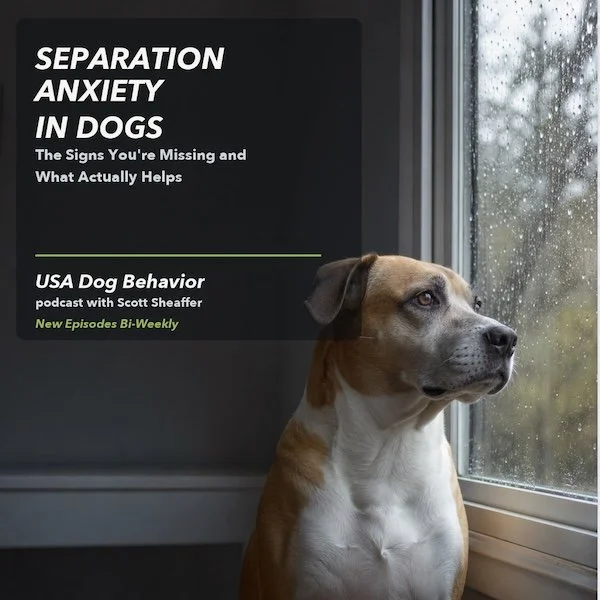
Prefer listening? This post is also available as an episode on the USA Dog Behavior Podcast—don’t forget to subscribe while you’re there if you haven’t already.
When a dog barks for hours, destroys a door, urinates indoors, or panics as an owner reaches for the keys, it is easy to call the behavior stubbornness, spite, or a training problem. It is none of those things. The dog may be experiencing genuine distress when left alone.
True separation anxiety is more than just a dog wanting to come with you. It can be a panic response tied to being separated from a particular person or from people in general. That distinction matters because the solution is not to make the dog “get over it” by leaving them alone longer. Repeated panic usually rehearses the problem instead of resolving it.
Start by Looking for the Pattern
The most useful first step is simple: record your dog when you leave. Set up a phone, pet camera, or other recording device and watch the first 20 to 30 minutes after departure. Many dogs with separation anxiety begin showing distress very quickly. This recording can also be shown to a canine behavior consultant if you seek assistance.
Common signs include pacing, whining, panting, drooling, trembling, persistent barking or howling, scratching or chewing around exits (especially the departure point of the owner), frantic attempts to escape, and house soiling that occurs only during absences. Most dogs with separation anxiety stop eating when left alone, even when offered something they normally love. That is useful information too.
Video also helps rule out look-alikes. A dog may bark at people passing a window, be bored, react to outside noise, dislike a crate, or have a medical issue affecting elimination. Destruction is not automatically separation anxiety. The timing, intensity, and what happens when no one is home tell the real story.
What Not to Do
Do not scold your dog for damage or accidents you discover after returning home. Those behaviors are symptoms of distress, not an attempt to punish you for leaving. Your dog cannot connect a delayed correction with something that happened while you were gone, and punishment can make departures feel even worse.
Also, do not assume a crate is the answer. A crate can be a helpful resting place for some dogs, but a dog who panics in confinement may become even more distressed and can injure themselves trying to escape. The safest setup is individualized for the dog. Use the camera to learn whether your dog does better in a crate, a dog-proofed room, or a larger area.
The First Part of Treatment is Management
While you are working on the problem, reduce the number and length of absences that trigger full panic whenever possible. This may mean coordinating schedules, using a trusted family member, hiring a sitter, or taking your dog with you when appropriate. This is not coddling. It prevents the dog from repeatedly practicing the fear response while you build a better plan.
Please note, your dog hates separation anxiety probably more than you do. It’s painful for them. They are not trying to do this to you; they are stressed, anxious, and fearful.
Provide a safe, low-stimulation area. White noise or calm music may help mask outside sounds for some dogs. A special food toy, a scatter of treats, or a meal can create a better association with alone time, but only if the dog is relaxed enough to eat. If your dog will not touch the food once you leave, that is a sign the exercise may already be too difficult.
Build Alone Time in Very Small, Successful Steps
The long-term work is gradual desensitization and counterconditioning. In plain language, you teach the dog that small pieces of separation are safe and predictable.
Start below your dog’s threshold, meaning before you see signs of worry. You might begin by moving a few feet away while your dog relaxes on a mat, stepping briefly behind a doorway, picking up your keys and putting them down, or opening and closing the door without leaving. Build duration, distance, and departure cues slowly. Change one variable at a time, and if your dog starts to worry, make the next repetition easier.
[This article is original content created by USA Dog Behavior (https://www.USADogBehavior.com) and is intended for our readers.]
This work requires patience. A dog who can handle ten seconds today is not ready for ten minutes tomorrow. The goal is not to test your dog. The goal is to create a long series of calm, successful repetitions. The more of these repetitions that you do each day—while they remain reasonably clam—the better. You really can’t overdo these reps as long as you are moving at a pace that keeps your dog well under panic levels at all times.
Your goal is to get your dog up to two hours of absence while they remain calm. Two hours is considered the tipping point for many, but not all, dogs. If your dog can tolerate two hours well, they can usually move a little more quickly up to three hours, four hours, etc.
Get the Right Help When the Problem is Serious
Separation anxiety can be severe, and some dogs benefit from a coordinated plan with a canine behavior consultant and a veterinarian. A medical examination can rule out problems that contribute to separation anxiety, although I find this to be rare in my experience. Your behavior consultant might also recommend you contact your veterinarian about behavior medication when anxiety is intense enough to interfere with learning. Medication is not a substitute for a behavior plan, but it can be an important part of making that plan workable for some dogs.
Avoid anyone promising a quick cure or recommending punishment, flooding, or forcing a dog to remain alone until they stop reacting. Humane, reward-based behavior work focuses on changing the dog’s emotional response, not suppressing the signs of fear.
Wrap-up
If your dog struggles when you leave, start with observation rather than assumptions. Record what happens, protect your dog from repeated panic when you can, and work in small steps that keep them under their panic threshold. Separation anxiety can be frustrating and emotionally exhausting, but it is treatable. When you understand the reason behind the behavior, you can build a plan that gives your dog a real chance to feel safe when home alone.
Prefer listening? This post is also available as an episode on the USA Dog Behavior Podcast—don’t forget to subscribe while you’re there if you haven’t already.
Additional Material:
Free Video: Understanding Dog Body Language
Free Video: Do Behavior Medications Work for Fearful and Aggressive Dogs?
© 2026 Scott Sheaffer. All rights reserved. Original content. Reproduction prohibited.