

Dogs constantly amaze us with their extraordinary abilities. There’s no doubt our four-legged family members are intelligent, but just how smart are dogs?
Researchers are racing to learn as much as they can, as canines are caught in a cultural shift: They’re being asked to do more than they ever have, from saving soldiers on the frontlines to detecting when a child is going to have a seizure to being expected to sit calmly in a cafe.
The more we understand canine cognition, the better our relationships with dogs can be.
What is Dog Intelligence?
Researchers say a dog’s learning ability depends on what you’re hoping the dog can do and the kind of smarts they need to pull it off.
“The way we think about intelligence in dogs nowadays is that there are a lot of different intelligences,” says Vanessa Woods, co-author of “Puppy Kindergarten” and director of Duke University’s Puppy Kindergarten. This research program collaborates with Eyes, Ears, Nose and Paws to study the cognitive development of puppies to identify clues that could make them better candidates for service dogs.
Humans and dogs share similarities in their cognitive development. “It’s the way you take in information from your five senses, that you see, hear, smell, taste, and feel, and use that to navigate your world and solve problems around you,” Woods says.
Each individual’s cognitive profile is what makes us—and our dogs—unique, with different intelligences, strengths, and weaknesses.
“Some people are really good socially but may not be very good at math. Someone good at expressing themselves orally may not be the best writer,” Woods says.
While comparing dog intelligence to humans has some analogies, there’s no quantifiable dog IQ number or SAT-score equivalent. However, scientists do have tools to evaluate how a dog’s mind works.
How Do Scientists Measure Dog Intelligence?
Woods and her team found that unlocking a dog’s abilities is similar to the challenges parents face: the goal is to find where they succeed.
“We really study dogs the way that we study young children,” Woods says. “We present them with a problem or a choice, and then we see how they solve it.”
One dog problem-solving experiment is the “cup test.” Researchers hide food under one of two cups, making sure the dog sees which cup it’s under, and then point to the cup without the food.
“If dogs follow their memory and pick the cup with the food, they may be more assertive and independent thinkers,” Woods says. “They may make good detection dogs.”
But if the dog chooses the cup without the food, that could indicate they’re trusting the information humans give to them, a quality important for companion or assistance dogs.
“Success is that you are well fitted to the environment that you’re in,” Woods says. “What we’re trying to figure out is how to find the best dog for the best job, sort of like early career aptitude.”
Another aptitude assessment Wood’s team uses is “the impossible test.” They put food in a Tupperware container and snap it shut.
Dogs who dive into trying to open the box may be more assertive and driven. But dogs that don’t react and make eye contact with humans to seek direction show strong dog communication skills.
The key to measuring dog intelligence is identifying areas where a dog thrives and working with them to reach their potential.
Types of Canine Intelligence
Dr. Stanley Coren, professor emeritus in the Department of Psychology at the University of British Columbia, an esteemed researcher and writer on dogs, presented three main pillars of canine intelligence in his book The Intelligence of Dogs.
The three types of intelligence are:
Instinctive Intelligence
Instinctive intelligence in dogs refers to what they were bred to do, for example, herding dogs herd and retrievers retrieve.
“You can usually catch this very early in a dog’s life,” Dr. Coren says. “I have seen retrievers at the age of six weeks run out and retrieve something, and he didn’t open his eyes until he was five weeks of age.”
Adaptive Intelligence
Adaptive intelligence in dogs refers to how quickly a pup adapts to what they learn in their environment and solves problems. Dog memory is important.
“Think of it as street smarts,” Dr. Coren says. “Adaptive intelligence is how a dog will solve new problems and use the abilities he’s learned.”
Working and Obedience Intelligence
Working and obedience intelligence reflect the dog’s cooperation skills and how well they learn commands.
“This is the type of intelligence people tend to care about the most,” Dr. Coren says. “It includes the ability to follow instructions humans give them.”
But what else signals a dog is bright?
Signs of a Smart Dog
Experts say there’s a range of signs that smart dogs exhibit, noting there’s no such thing as a dumb dog; all dogs have different talents. If you’re looking to determine what kinds of intelligence your dog might have, ask yourself the following questions:
- Does the dog have a good understanding of language and human gestures?
- Does the dog demonstrate cooperation skills, sociability, and emotional awareness?
- Do they learn tricks, cues, and solve problems quickly?
- Do they demonstrate balanced dog social skills with people and other dogs?
The key to a successful relationship is making sure your pup’s intelligence matches your lifestyle, and your dog’s emotional and enrichment needs are being met.
“There are situations where some dogs are going to thrive,” Woods says. “If a dog is herding sheep and running 20 miles a day, that’s going to be amazing for one dog, but if you put that dog in an apartment and expect them to be in a crate eight hours a day, then that dog’s really going to struggle.”
Breed Differences: Which Dogs Are the Smartest?
The impact of breed on intelligence is a widely discussed topic.
Decades ago, Dr. Coren published a now well-known list ranking the working and obedience intelligence of purebred dogs.
“I contacted every single dog obedience judge in the U.S. and Canada,” Dr. Coren says. “Ultimately, I got complete rankings from 209 dog judges. They filled in a complex and time-consuming questionnaire, in which they ranked various dog breeds.”
Border Collies, Poodles, German Shepherds, Golden Retrievers, and Doberman Pinschers ranked among the brightest dogs.
The Borzoi, Chow, Bulldog, Basenji, and Afghan Hound ended up at the bottom of the list.
These days, researchers are using canine cognition labs and citizen science (public participation) to study dogs and the potential impact of breed on intelligence.
While breed may play a role in a dog’s instinctive behavior, training, socialization, and cognitive enrichment are all critical components, and of course, every dog is different.
Dr. Coren recommends choosing a dog whose temperament fits your family well, rather than choosing dogs ranked highly for intelligence who may need a lot of stimulation.
“Many need a job to do; if they get bored, they may shred your furniture,” Dr. Coren says. “Some of the dogs at the bottom of the list make wonderful companions. The different intelligences make a difference in the dog’s abilities and also what you might want out of the dog.”
Famous Examples of Smart Dogs
Some real-life famous smart dogs have astounded researchers, like Rico and Chaser.
Rico, a Border Collie in Germany, became famous for his incredible ability to understand language. He knew more than 200 different words, all toy names, which he could fetch even four weeks after initially being exposed to the word.
Another Border Collie, Chaser, is considered the smartest dog in the world. She was trained by behavioral psychologist John W. Pilley in South Carolina.
Chaser knew the meaning of 1022 words; the names of her toys, which she could identify and retrieve. Chaser had the largest memory of any animal tested and mastered a dog’s understanding of language.
Pilley co-authored a book about her astonishing skills, Chaser: Unlocking the Genius of the Dog Who Knows a Thousand Words.
How to Test Your Dog’s Intelligence at Home
Could you have a smarty-pup like Rico or Chaser in the making? How can you test your dog’s intelligence? Woods suggests trying the impossible task and cup test mentioned in this article. “It shows you whether your dog is a really independent problem solver or whether they rely on you,” she says.
Dognition, co-designed by Woods’ husband Brian Hare, Ph.D., director of the Duke Canine Cognition Center, offers 20 games to play with your dog at home and gives you a report assessing your dog’s “unique genius.”
Dr. Coren’s book includes a list of 12 tests.
College canine cognition labs, like Occidental College, are often looking for pet parents to participate in research testing dog intelligence.
Can You Improve Your Dog’s Intelligence?
Experts say nurturing dogs’ cognitive abilities through training, play, and mental stimulation keeps their minds active and could improve their intelligence.
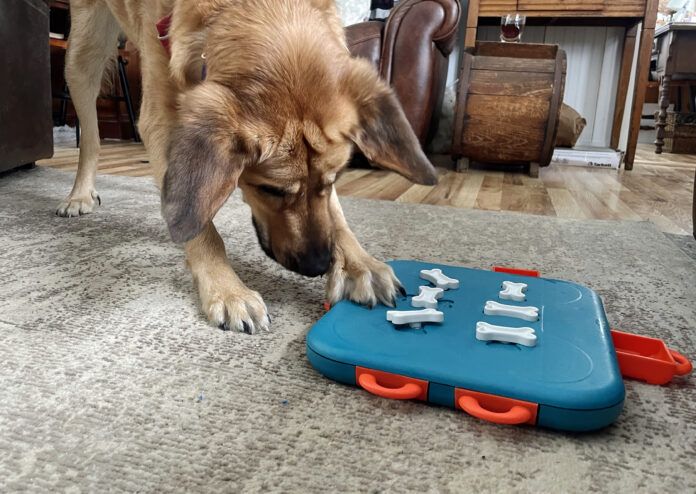
You can try puzzle games, food-foraging toys, and enrichment activities.
“I think that traditionally, the way owners have engaged with their dogs has been really passive, like, throwing balls or taking them around the block while you read your phone,” Woods says. “These cognitive games not only keep their minds active, but it also improves your relationship, and gives you a window into how your dog thinks.”
How Smart Are Dogs?
How smart is your dog? Every pup has their distinct genetic makeup, training, and background. It’s what makes them your treasured family member.
While intelligence comes in many forms, if you can unlock and appreciate your dog’s unique inner genius, it may strengthen the bond between you both.
