If you are the parents of kids and a family dog (or several dogs), you may also have a home where neighbor children come to play and hang out, which more than likely includes running, screaming, laughing, and throwing things. Your dog may want to get involved…or want to get away. Maybe your dog was napping when the door bursts open and startles your dog with these noises and movements. Emotions and arousal can escalate.
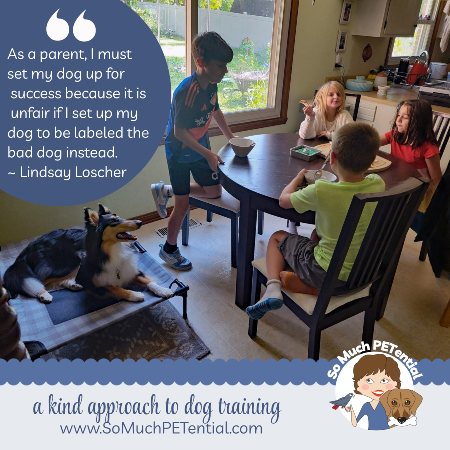
This is when the potential for danger, and the potential for your dog to escape, can occur.
I am sure I don’t need to tell you, a home with kids and a family dog has its challenges!
As a parent, this is A LOT to manage. I get it. You are probably juggling so many things at any given time. Supervising all these encounters can seem like a daunting task on top of everything else for which you are responsible.
I was talking to one of my clients the other day about this very subject. She has a young daughter and son, and a very energetic, life-of-the-party adolescent family dog.
Lindsay was sharing with me how overwhelming it can be at times. They (she and her husband) want to encourage neighbor kids to feel comfortable coming to them; and, so, it is a daily occurrence for a pack of kids to play inside and outside, going from one home to another.
She may be busy in the kitchen or getting other work done when the door suddenly opens and young bodies come running through. With warm weather upon us, they are likely to go straight for the family’s fenced in back yard to do what kids will do outside (which means coming through the front door, into the kitchen and family room area, and out the patio door). As you can imagine, it can get a little noisy.
For their collie, Lucky, this is an exciting interruption to her day! If she has access, she will greet her young friends by jumping on them or running in circles. She is more than happy to follow them too!
Once outside, more chasing, jumping, grabbing, and barking is what can come next.
Meanwhile, Lindsay has housework to do, dinner to prepare, phone calls to make. She doesn’t always have time to be with the kids, actively supervising. “It can be overwhelming,” she told me.
Why is pro-active management planning is so important for parents?
Here are my top reasons:
There is a real liability issue if anything were to happen to children on your property because of your dog. Dog bite prevention is an important consideration.
You may be thinking that isn’t so much of a concern as these kids are all neighbor kids, but I am sure you would feel awful if anyone was injured because of playing at your home.
You AND your kids would not like it if your dog got labeled ‘aggressive’ or a ‘biter’ by the neighborhood.
You would also not like it if your dog is injured or frightened and develops fear of children as a result.
You AND your kids would be hurt if your dog ran away through an open door.
Really, active adult supervision when active kids and dogs are playing together should ALWAYS be the plan.
Let’s take Lucky as an example.
While she is a dog who thoroughly enjoys adding energy to any get together, like any dog, her enthusiasm and arousal can increase fast. Being an adolescent, she is still developing her fine motor skills and her decision making isn’t always the best, especially in situations like this.
Accidents can happen. Her teeth may grab at skin. Her body may knock a child over. Kids may react by yelling at her, grabbing her collar or pushing her. They may also want to give Lucky a bear hug, and many dogs do not like that.
Even the most tolerant dog is going to have a breaking point. Good stress or bad stress, it can stack and lower a dog’s ability to cope. Dog bites do not happen out of the blue.
There are other breeds whose arousal can spike even quicker than Lucky, in different ways, and unfortunately, sometimes spiked arousal can lead to aggressive dog behaviors.
Meanwhile learning is happening all the time. Associations (referred to as conditioned emotional responses) are formed based upon past experiences. Lucky and other family dogs are learning to associate kids with high emotion, high energy, jumping, chasing, nipping, and barking. The expectation then for her and others, is that the presence of kids means excitement.
Other dogs may not enjoy children the way that Lucky does. Kids’ unpredictability and loud noises can be scary for many, who may feel unsafe without certainty. These dogs may try to get away but may not be able to. Tight spaces can cause them to feel more uneasy. Kids who are unable to interpret and act upon dog body language, can intrude on personal space, and give dogs more reason to be defensive.
Something else may also occur on these afternoons.
Doors that are flung open, maybe not even fully closed, can be a quick exit for family dogs – whether a dog wants to be off to explore or wants to escape.
What does pro-active management planning for kids and dogs look like?
Here are some tips to consider:
Lock all of your doors and ask kids to ring your doorbell or text your cell phone to come in.
If you would like to allow easier access, only have ONE door open for neighbor kids so that you can manage around that single entry.
Use a double gated barrier around the entrance way to lower the risk of your dog escaping and having direct access to little bodies as they come through the door. You can also install a gate at the entrance to hallways leading to that door.
Have the kids play in a separate area from your dog. Lindsay will have boys either play in their basement or outside. She has gates separating the sliding glass door leading to outside and the kitchen area.
Keep your family dog with you while the neighborhood kids are playing elsewhere. You can give your dog an activity to do within your space.
Take a few minutes to oversee structured enrichment time that includes the kids. With your supervision, they can create food scatters, food paths, hide food and then ask them to sit in an area while your dog does the activity. Kids can also prepare food stuffed toys.
If your dog knows behaviors fluently, you can practice having the kids, one child at a time, ask your dog to do a behavior, telling your dog GOOD, and then tossing a treat.
Encourage kids to do a calm activity while your dog is settle on a bed or mat, with you in the same room.
I love Lindsay’s perspective as a parent. “I must set my dog up for success because it is so unfair if I set up my dog to be labeled the bad or dangerous dog.”