

As an Amazon Associate I earn from qualifying purchases. Learn More
Updated September 2026
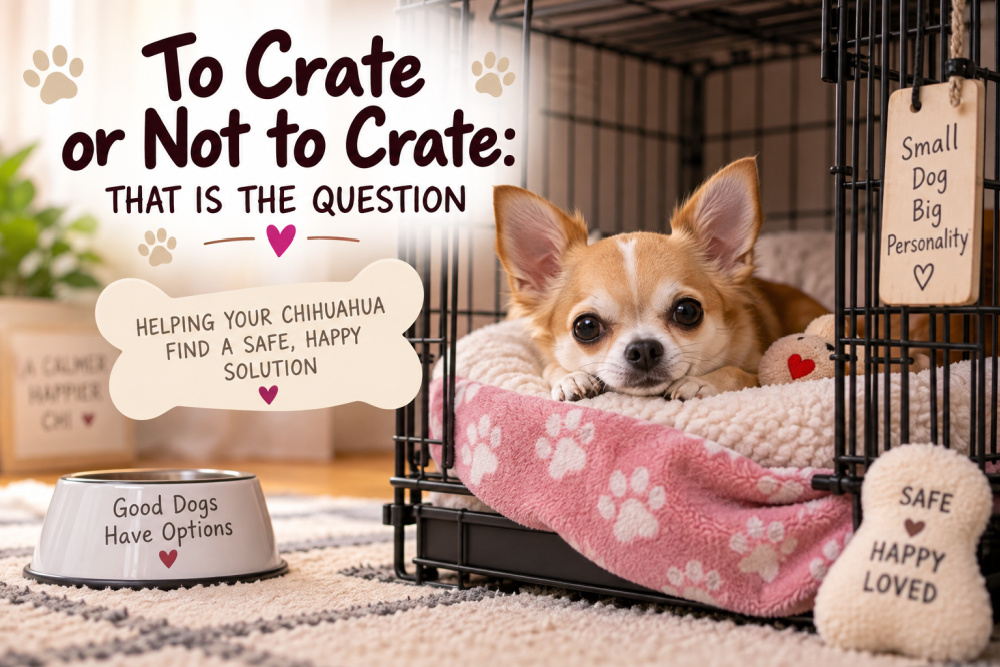
Crate training can be a surprisingly controversial subject among dog owners. Some people swear by crates and consider them one of the most useful tools they have, while others don’t like the idea of putting their dog in a cage at all.
So, who’s right?
The truth is somewhere in the middle.
When introduced properly and used responsibly, a crate can become a comfortable, secure place where your Chihuahua chooses to rest. It can also make house training, travel, vet visits, and life with a new puppy much easier.
But crates aren’t right for every dog, and they should never be used as punishment or as a place for a dog to spend most of the day.
Let’s look at the pros and cons of crate training, how to do it correctly, and what you can do if your Chihuahua simply doesn’t like being crated.
Is Crate Training Cruel?
Crate training itself isn’t cruel. How the crate is used makes all the difference.
A properly used crate should be a comfortable, positive place—not somewhere your Chihuahua is sent when they have done something wrong.
Many dogs learn to enjoy having a quiet space of their own. You may eventually find your Chihuahua wandering into their crate voluntarily to take a nap or get away from household activity.
On the other hand, leaving a dog confined for excessive periods, forcing a terrified dog into a crate, or using the crate as punishment can cause fear and anxiety.
Humane World for Animals recommends making the crate a pleasant place and introducing it gradually rather than forcing a dog inside.
The goal isn’t simply to teach your Chihuahua to tolerate being locked in a crate. You want them to feel safe and relaxed there.
Benefits of Crate Training a Chihuahua
There are several reasons why it’s useful for a Chihuahua to be comfortable in a crate.
House Training
A crate can be a helpful part of potty training because it limits your puppy’s access to the house when you can’t supervise them.
However, a crate isn’t a substitute for frequent potty trips, particularly with a young Chihuahua puppy.
Keeping a Curious Puppy Safe
Chihuahua puppies may be tiny, but they can get into an amazing amount of trouble.
Electrical cords, dropped medications, houseplants, children’s toys, food wrappers, and countless other things can become dangerous when an unsupervised puppy decides to investigate them.
A crate or exercise pen gives you a safe place for your puppy when you can’t keep your eyes on them.
Travel
A Chihuahua who is comfortable in a crate will often find traveling less stressful.
Crates may also be necessary during airline travel and can provide secure containment during car trips.
Veterinary Care
There may be times during your Chihuahua’s life when they need to stay at a veterinary hospital or be confined during recovery from an illness, injury, or surgery.
A dog who is already comfortable with confinement may find the experience less stressful.
Emergencies and Evacuations
Hopefully you’ll never need to evacuate your home because of a hurricane, fire, flood, or another emergency, but crate training can make these situations much easier.
Emergency shelters, hotels, temporary housing, or transportation may require your dog to be confined.
A Quiet Retreat
A crate can also give your Chihuahua somewhere to escape when the house gets busy.
This can be particularly helpful during parties, holidays, visits from children, repair work, or other situations that may be overwhelming.
If your Chihuahua goes into their crate voluntarily, make sure everyone in the family understands that this is their quiet space. Children especially should be taught not to reach into the crate or bother the dog while they’re resting.
When You Should NOT Use a Crate
Although crates have many uses, there are situations where they aren’t appropriate.
Don’t use a crate:
- As punishment.
- To keep your Chihuahua confined for most of the day.
- As a replacement for exercise, play, training, or companionship.
- To avoid dealing with a behavioral problem.
- To confine a dog who is panicking or injuring themselves trying to escape.
- As the sole treatment for separation anxiety.
- For longer than your puppy can reasonably control their bladder and bowels.
If your Chihuahua is showing extreme distress in a crate, don’t assume they are simply being stubborn.
What Size Crate Does a Chihuahua Need?
Your Chihuahua should have enough room to:
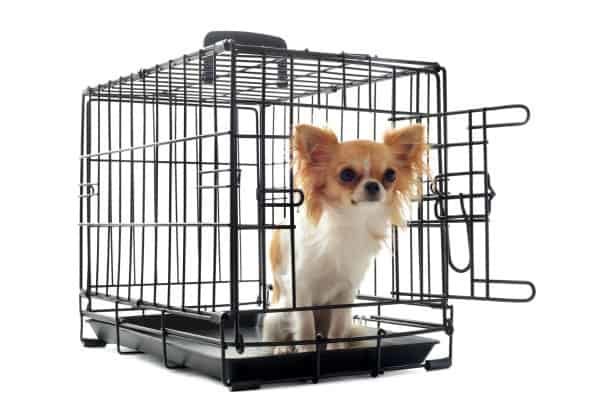
Your Chihuahua’s crate should be large enough for them to sit, stand, lie down, stretch out, and turn around comfortably. The RSPCA recommends choosing a crate that allows your dog to do all of these things comfortably.
You don’t need an enormous crate for such a tiny dog.
If you’re buying a crate for a puppy, you can purchase one large enough for their expected adult size and use a divider while they’re small.
There are several types of crates available.
Wire Crates
Wire crates provide excellent ventilation and visibility and usually fold flat for storage. Many include dividers, which make them convenient for puppies.
Some dogs also enjoy having part of a wire crate covered with a lightweight crate cover or blanket because it makes the space feel quieter and more private.
Never completely cover a crate in a way that restricts ventilation or causes it to become too warm.
Plastic Crates
Plastic crates are more enclosed and may feel cozier to some dogs. They’re also commonly used for travel.
Soft-Sided Crates
Soft crates are lightweight and portable but aren’t a good choice for a puppy or dog who chews, scratches, or tries to escape.
Where Should You Put the Crate?
At first, put the crate somewhere your family spends time rather than isolating your Chihuahua in a distant room.
A corner of the living room or family room often works well.
Keep the crate away from:
- Direct sunlight.
- Heating vents.
- Space heaters.
- Cold drafts.
- Other areas that become unusually hot or cold.
This is particularly important for Chihuahuas because their small bodies can make them more vulnerable to temperature extremes.
At night, many people initially keep a puppy’s crate in or near the bedroom. This also makes it easier to hear a young puppy who needs a nighttime potty trip.
Once your Chihuahua is comfortable sleeping in the crate, you can decide whether you want to keep it there or gradually move it elsewhere.
Crate Safety Tips for Chihuahuas
Because Chihuahuas are so small, there are a few extra precautions worth taking.
Check the Bar Spacing
Make sure a tiny Chihuahua puppy can’t get their head, jaw, leg, or paw caught between the bars.
Inspect the crate periodically for bent wires, sharp edges, loose pieces, or other damage.
Remove Collars and Harnesses
It’s generally safest to remove collars, harnesses, and dangling identification tags when your Chihuahua is left unattended in a crate.
A collar or tag can become caught on part of the crate and create a strangulation hazard.
Your dog should still be microchipped and have identification available when they’re outside the crate.
Be Careful About What You Leave Inside
Comfortable bedding is fine for most dogs, but puppies who shred and eat bedding may need a safer alternative.
The same applies to toys and chews. Something that is perfectly safe while you’re sitting nearby isn’t necessarily something you should leave with your dog unattended.
Consider Water
Your Chihuahua should have regular access to fresh water. A crate-mounted water bowl can be useful because it is harder to tip over.
How to Crate Train a Chihuahua
Some Chihuahuas accept a crate almost immediately. Others need days or even weeks.
There is no prize for doing it quickly.
The important thing is to move at your dog’s pace.
Step 1: Let Your Chihuahua Explore
Set up the crate with the door securely propped open.
Toss a few treats near the entrance and allow your Chihuahua to investigate.
Then toss treats just inside.
Gradually toss them farther toward the back.
Don’t push, pull, or place your Chihuahua inside the crate. You want them to make the decision to enter.
If they walk inside, praise them and offer another treat.
Then let them come right back out if they want to.
Do this several times throughout the day.
Step 2: Feed Meals in or Near the Crate
Once your Chihuahua is comfortable approaching the crate, start feeding meals near it.
Gradually move the food bowl inside.
If your dog happily walks all the way in to eat, wonderful.
If they only feel comfortable eating with their front feet inside, that’s okay too. Move more slowly.
Step 3: Close the Door Briefly
Once your Chihuahua is happily eating or relaxing inside, briefly close the door.
We’re talking seconds at first—not an hour.
Open it again before your dog becomes worried.
Gradually increase the amount of time the door stays closed.
You can sit next to the crate, read, watch television, or do something else quietly so your Chihuahua learns that being behind a closed crate door isn’t a big deal.
Step 4: Move Away From the Crate
Once your Chihuahua can relax for several minutes with the door closed, start moving around the room.
Then briefly leave the room.
Come back calmly.
Gradually increase how long you’re out of sight.
If your Chihuahua becomes distressed, you’ve probably moved ahead too quickly. Go back to an easier step for a while.
Step 5: Practice Short Departures
Once your Chihuahua can remain relaxed in the crate while you’re in another room, practice leaving the house for very short periods.
Your first departure doesn’t need to be a shopping trip.
Walk outside for a minute and come back.
Then try a few minutes.
Build up gradually.
It’s also a good idea to occasionally crate your Chihuahua for short periods while you’re home. Otherwise, they may learn that going into the crate always means you’re leaving.
What If My Chihuahua Cries in the Crate?
This is where you have to do a little detective work.
A Chihuahua crying in a crate may be saying:
“I don’t like this yet.”
But they could also be saying:
“I have to go potty!”
Or even:
“I’m terrified!”
Those situations shouldn’t be treated the same way.
A young puppy who suddenly wakes up and cries during the night may genuinely need to go outside.
If you think that’s the case, take them calmly to their potty area. Keep the trip boring—this isn’t playtime—and then return them to bed.
If your Chihuahua gives a little protest whine and then settles down, that’s different from true distress.
Signs that your dog may be extremely distressed include:
- Frantic attempts to escape.
- Heavy panting when they aren’t hot.
- Excessive drooling.
- Continuous barking or screaming.
- Biting or pulling at the crate.
- Cowering.
- Refusing high-value treats they would normally love.
- Injuring themselves while trying to escape.
If you see these behaviors, don’t simply let your Chihuahua “cry it out.” Back up in the training process and consider getting professional help if the problem continues.
How Long Can a Chihuahua Stay in a Crate?
This is one of the most important questions about crate training.
A crate isn’t intended to be somewhere a dog spends an entire workday on a regular basis.
Humane World for Animals recommends that puppies younger than six months not remain crated for more than about three to four hours at a time because they can’t reliably control their bladder and bowels that long.
Young puppies may need bathroom breaks much more frequently than that.
Even an adult dog who can physically hold their bladder for a long time shouldn’t routinely spend most of the day confined to a crate.
Dogs need opportunities to:
- Walk and exercise.
- Stretch.
- Explore and sniff.
- Go to the bathroom.
- Play.
- Interact with people.
- Simply move around.
If you’re regularly away for a full workday, consider using a larger safe area or arranging for someone to give your Chihuahua a break.
Alternatives to a Crate
Crates aren’t the only way to keep a Chihuahua safe while you’re away.
In fact, some dogs do much better with a little more room.
Exercise Pen
An exercise pen is one of my favorite alternatives for a small dog. I used one of these for my dogs while they were puppies.
Because Chihuahuas don’t require much space, even a relatively small exercise pen can provide room for a bed, water, toys, and some movement.
Just make sure the pen is secure. Never underestimate a determined Chihuahua!
Baby-Gated Room
A puppy-proofed bathroom, kitchen, laundry room, or other small area can work well.
Check carefully for electrical cords, cleaning products, medications, trash cans, small objects, and anything else your Chihuahua could reach.
Dog-Proofed Room
Older, trustworthy dogs may eventually graduate from a crate to having access to an entire dog-proofed room.
Later, they may be able to have free run of the house.
Dog Walker or Pet Sitter
If you’re gone for long stretches, having someone stop by during the day gives your Chihuahua a bathroom break, exercise, and some human interaction.
Doggy Daycare
Some Chihuahuas love daycare.
Others would rather spend eight hours listening to a smoke detector beep than hang out with a bunch of strange dogs.
You know your dog.
If you’re considering daycare, look for a facility that carefully evaluates dogs, supervises interactions, separates dogs appropriately by size and play style, and provides opportunities for rest.
Requirements vary among facilities, so ask about vaccination requirements, temperament evaluations, age restrictions, and other policies.
What About Leaving a Chihuahua in a Fenced Yard?
I don’t recommend leaving a Chihuahua outside unattended as an alternative to crating.
A fence doesn’t protect a small dog from every danger.
Depending on where you live, risks can include predators, extreme temperatures, escape, theft, toxic plants or substances, and other animals.
A Chihuahua can also fit through surprisingly small gaps.
Supervised backyard time is wonderful. An unattended yard isn’t the same thing as a secure indoor area.
What If My Chihuahua Hates the Crate?
This is important: not every dog needs to love a crate.
I have had a dog who completely freaked out if she even saw a crate.
For a dog like that, forcing the issue isn’t necessarily the answer.
Some dogs have had frightening experiences with confinement before coming into our lives. Others simply find being enclosed extremely stressful.
You can try slow, positive crate training, but if your Chihuahua continues to show genuine fear or panic, consider whether an exercise pen or safe room would accomplish the same goal without causing so much stress.
The goal is to keep your dog safe—not to prove that you can make them accept a crate.
Crates and Separation Anxiety
If your Chihuahua panics whenever you leave, a crate isn’t a treatment for separation anxiety.
In fact, severe separation anxiety combined with confinement can be dangerous. Some dogs will bite crate bars, claw at doors, or otherwise hurt themselves trying to escape.
If your Chihuahua shows intense distress when left alone, talk with your veterinarian. They may recommend working with a qualified veterinary behaviorist or another appropriately credentialed behavior professional.
Treat the underlying anxiety rather than simply trying to prevent the resulting behavior.
When Can You Stop Using the Crate?
There’s no particular age when a Chihuahua has to stop using a crate.
Some dogs continue sleeping in an open crate their entire lives simply because they like it.
What can eventually change is the need to close the door.
Once your Chihuahua is reliably house-trained and can safely be left alone without destructive behavior, you can experiment with giving them more freedom.
You might progress from:
Crate → exercise pen → dog-proofed room → larger area of the house
There’s no hurry.
And if your Chihuahua loves sleeping in their crate, you don’t have to take it away. Just leave the door open and let them choose.
Frequently Asked Questions About Crate Training Chihuahuas
Should a Chihuahua Sleep in a Crate at Night?
They certainly can, provided your Chihuahua is comfortable in the crate and their needs are being met.
For a young puppy, keeping the crate near your bed can make it easier to hear when they need a nighttime potty break.
An adult Chihuahua who is reliably house-trained doesn’t need to sleep in a crate unless you prefer it or your dog enjoys it.
And, of course, plenty of Chihuahuas would like to point out that your bed is also an option.
Should I Put My Chihuahua’s Crate in My Bedroom?
It’s often helpful when you’re first crate training a puppy.
Being near you may help your puppy feel less isolated, and you’ll be able to hear when they wake up and need to potty.
You can always move the crate later if you prefer it somewhere else.
Should I Cover My Chihuahua’s Crate?
Some dogs find a partially covered wire crate cozy and calming.
Others prefer to see everything happening around them.
Try it and see what your Chihuahua prefers.
Always make sure there is plenty of ventilation and that the crate doesn’t become too warm.
Should I Put Food and Water in the Crate?
Feeding meals in the crate can be a great tool during crate training because it helps create a positive association.
Your Chihuahua should also have appropriate access to fresh water. A crate-mounted bowl can help prevent spills.
What If My Chihuahua Won’t Go Into the Crate?
Don’t force them.
Start with treats outside the crate and gradually move them closer to the entrance. Eventually place treats just inside.
The first goal may simply be getting one paw inside.
That’s progress.
Let your Chihuahua set the pace.
Can I Crate a Chihuahua With Separation Anxiety?
This should be discussed with your veterinarian or a qualified behavior professional.
A dog with severe separation-related distress may panic when confined and can potentially injure themselves trying to escape.
A crate by itself won’t cure separation anxiety.
Is a Playpen Better Than a Crate for a Chihuahua?
Sometimes!
A playpen provides more room to move while still keeping a tiny dog safely contained.
For longer periods during the day, a properly secured exercise pen or dog-proofed room may be a better choice than a crate.
It depends on your Chihuahua’s age, temperament, house-training progress, and behavior.
Final Thoughts: To Crate or Not to Crate?
Crate training isn’t an all-or-nothing decision.
A crate is simply a tool.
For some Chihuahuas, it becomes a favorite little bedroom—a place where they happily curl up for a nap and get away from the world.
For others, an exercise pen, gated room, or dog-proofed area works much better.
What matters is that your Chihuahua feels safe.
If you decide to crate train, introduce the crate gradually, keep the experience positive, provide plenty of time outside the crate, and pay attention to what your dog is telling you.
And if your Chihuahua decides that crates are absolutely unacceptable but happily snoozes all afternoon in a playpen?
That’s okay too.
As with so many things involving Chihuahuas, sometimes they have their own opinion about how things are going to be done.




Pet Blogger
I have had dogs all my life. I have been a pet groomer, worked in a pet hotel, and a kennel, and have bred and showed dogs.
Post Views: 7,743