




A dog bleeding from the butt could be a simple case of mild irritation, or it could indicate a serious clotting disorder. If your dog just has mild intermittent bleeding, he probably has a minor issue such as intestinal worms or an impacted anal gland. If the bleeding is severe or he has other signs of illness, call your veterinarian immediately.
Hematochezia in Dogs
Hematochezia is when there is bright red, fresh blood in your dog’s stool. You might notice the blood as your dog defecates, but more likely you will spot it as you scoop or bag the poop for disposal.
Bright red blood on or in the stool comes from either the colon (large intestine) or your dog’s rectum or anus. Blood from the small intestines will appear dark and tarry when passed in the stool and is called melena. Why the color difference? Blood that originates in the small intestines gets partially digested before it is passed in the stool whereas blood from the large intestine and beyond is passed fresh.
Rectal Bleeding in Dogs
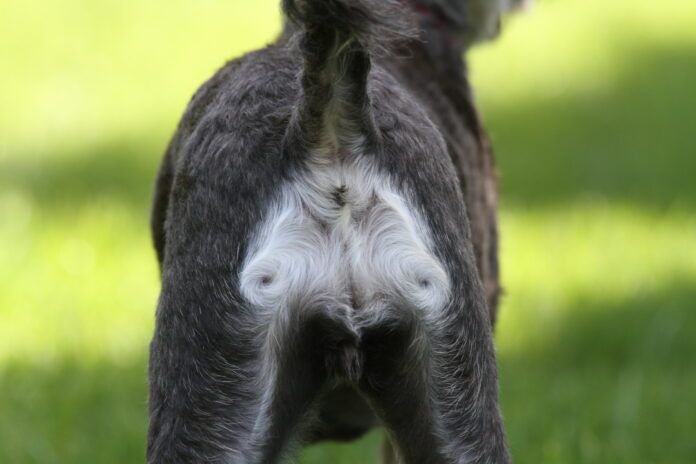
A dog bleeding from the butt does not have to be associated with defecation. You might notice a small trail of blood from your dog’s anus, or blood spotting when he sits or lies down. This type of bleeding is usually due to an issue in the perianal area on your dog’s back end near his anus, or from just inside the rectum.
Why is My Dog Bleeding from the Butt?
There are many potential causes for hematochezia and rectal bleeding in dogs such as:
- Dietary indiscretion
- Intestinal obstruction
- Trauma to the intestines, rectum, or perianal area
- Internal parasites
- Constipation
- Diarrhea
- Impacted or infected anal sac(s)
- Ruptured anal sac(s)
- Ulcers within the digestive tract
- Perianal fistulae
- Irritable bowel disease (IBD)
- Acute hemorrhagic diarrhea syndrome (AHDS)
- Viral diseases such as parvovirus, especially in unvaccinated puppies
- Clotting disorders due to toxicity, Rocky Mountain Spotted Fever, Von Willebrand disease, etc.
- Cancer in the GI tract or perianal area
If your dog is acting normal, or just has mild diarrhea, you can drop a stool sample off at your veterinary office. The staff will do a fecal exam to check for parasites.
If the bloody stool persists more than a day or two or if your dog is showing other signs of illness, he will need a veterinary exam to figure out what is going on. Your vet will ask questions about your dog’s behavior and recent activities, stool quality, and any changes in his routine (including getting into something).
Some tests your vet may recommend include:
- Fecal exam
- Anal sac expression
- Rectal exam
- X-rays and/or ultrasound
- Bloodwork
- Parvo test
- Endoscopy or colonoscopy
The exact tests will depend on what symptoms your dog is showing and which problem(s) your veterinarian thinks is the most likely cause.
Causes of Hematochezia in Dogs
Intestinal Parasites
Intestinal parasites can range from worms to protozoa and several types can cause hematochezia in dogs. Any dog living in any location can be exposed to these parasites! Most worms are spread in feces, so dogs can contract them by sniffing infected feces from wildlife, other dogs, or cats. Protozoa such as giardia can also be picked up from contaminated water and soil. Puppies and immunocompromised dogs are at highest risk of illness from a heavy parasite load.
Dogs with a heavy parasite load may lose weight or, in the case of young puppies, fail to thrive and grow normally.
Many parasites can be prevented with regular deworming. If your dog is not on a regular deworming schedule, or if he has a parasite that isn’t covered by your usual product, your veterinarian will prescribe an appropriate treatment.
Poop Woes
Both constipation (large, hard stools that are difficult to pass) and diarrhea (soft, loose stools) can cause bleeding as your dog strains to defecate. In most cases where there is just a small amount of blood in or on the stool, the blood is not a big deal—focus on getting treatment for the constipation or diarrhea and the bleeding will resolve.
A large amount of blood in or on the stool, or bloody stool that persists for several days, may be more significant. Heavy bleeding when defecating could indicate an injury within the rectum or colon or a health condition that is causing bleeding within those organs.
Both constipation and diarrhea can be helped by giving a probiotic or some plain canned pumpkin on a regular basis. Severe constipation may require enemas at the vet clinic or manual deobstipation under sedation. Your vet may also prescribe laxatives. Severe diarrhea may require medications from your vet. Vomiting and diarrhea at the same time is an emergency.
Anal Sac Problems
The anal sacs are located just inside your dog’s anus and are supposed to empty a bit each time your dog poops. This material is what gives your dog’s stool its lovely aroma. The anal sacs can become impacted for a number of reasons, which in turn leads to buildup, discomfort, and eventually infection or rupture of the sacs.
Scooting is a very common sign of anal sac issues, but you may also see your dog licking and chewing at his back end frequently or notice reddened skin around the anus. You may also see foul-smelling discharge from the anus, potentially tinged with blood. The blood may be from the irritated anal sacs themselves, or from damage to the anus as your dog licks and chews at the area.
Your veterinarian will palpate the anal glands and express them manually if needed. In case of infection or rupture, pain meds and antibiotics will be prescribed.
Intestinal Obstruction
If your dog ate something he shouldn’t have and it is stuck in his GI tract, this can cause diarrhea with or without blood, vomiting, weight loss, and lethargy. Make note of anything that goes missing in your home or yard, especially if your dog likes to chew.
Obstructions can often be seen on x-rays. The item might pass on its own or require removal via endoscopy, colonoscopy, or abdominal surgery. Linear foreign bodies, such as string, fishing line, rope, or tinsel, require immediate surgical intervention to prevent severe damage to the intestines.
Perianal Fistulae
A perianal fistula is a draining tract located around the anus. This is an autoimmune disorder most common in German Shepherd Dogs, but any dog can be affected. Dogs usually have multiple open crevices around the anus which drain pus and blood. This condition is extremely painful, and the dogs often struggle to defecate.
Perianal fistulae often cannot be cured and require lifelong treatment with immunomodulating medications such as cyclosporine.
Irritable Bowel Disease
IBD is a frustrating condition as it is difficult to diagnose and to manage. Affected dogs often experience chronic diarrhea—which may or may not be accompanied by hematochezia—weight loss, and may have poor appetite or energy levels. They may also vomit frequently. IBD is considered an autoimmune disorder and food allergies or intolerances can play a role.
Treatment often consists of diet trials, prescription food, probiotics, immune medications, and/or other medications depending on the case.
Acute Hemorrhagic Diarrhea Syndrome
Also known as hemorrhagic enteritis or hemorrhagic gastroenteritis, acute hemorrhagic diarrhea syndrome (AHDS) is when the dog has severe bloody, watery diarrhea due to intestinal inflammation and bleeding. AHDS can occur on its own, or may be concurrent with IBD, parvovirus, or pancreatitis.
Dogs with AHDS are often very sick, and also likely to vomit (possibly with blood). AHDS is an emergency as the dog can become dehydrated and go into shock quickly. Treatment consists of hospitalization with IV fluids, pain and antinausea medications, and probiotics.
Parvovirus
Parvo is an extremely contagious viral disease in canines that causes severe diarrhea and lethargy. If left untreated it is often fatal, especially in puppies.
If your puppy has not completed his parvo vaccine series and has more than one bout of diarrhea, with or without blood, this is an emergency.
Treatment consists of supportive care (often in the hospital), fluid therapy, antinausea medications, and antibiotics. There is a monoclonal antibody injection that can help to reduce viral replication, but this is not widely available and is expensive.
Parvo can be prevented with vaccination. All healthy dogs and puppies should be vaccinated against parvo, both to protect the individual dog and to keep puppies and immunocompromised dogs in our communities safe from this disease.
Clotting Disorders
Clotting issues can be caused by genetic disorders such as Von Willebrand disease, acquired diseases such as Rocky Mountain Spotted Fever, or consuming a toxic substance such as rat poison.
If your dog is not clotting normally, you may notice blood on his stool, bleeding from the rectum, bruising on his body, or pinpricks of red across large areas of his body. Cuts and scrapes may bleed longer than expected.
Treatment will vary depending on why your dog is not clotting normally. Emergency care and blood transfusion may be necessary in some cases.
Cancer
Malignant tumors within the GI tract or in your dog’s perianal area can either bleed or cause bleeding in the surrounding tissues. Dogs with cancer often experience unexplained weight loss and may be lethargic with a poor appetite. Depending on the location of the tumor, you may see a visible mass on your dog’s back end that is ulcerated and irritated, or may just see periodic bleeding from the anus.
Perianal tumors and anal sac tumors can often be removed surgically. In intact male dogs, perianal adenomas are a benign tumor that can be cured with castration. Chemotherapy, radiation, and supportive care may all be options depending on your dog’s exact tumor type and overall condition.
Minor Causes Hematochezia in Dogs
If your dog seems happy and healthy and just has a little blood on his stool, he probably either ate something that he shouldn’t have that scraped or irritated his GI tract or had a particularly large and firm stool that damaged his anus as he strained to defecate. Something like this that happens only rarely is nothing to worry about, but if it happens frequently, talk to your veterinarian.
Treatment for a Dog Bleeding from the Anus
Treatment will vary depending on what has caused your dog to bleed rectally or have blood on his stool. Minor GI upset can usually be treated by feeding a bland diet for a few days until your dog is passing normal stools. More serious illnesses may require medications and/or supportive care from your veterinarian.
When to See a Vet About Rectal Bleeding or Blood in Your Dog’s Stool
Call your veterinarian if your dog:
- Has had mild bleeding from the rectum or blood in his stool for more than 48 hours
- Has severe rectal bleeding or diarrhea
- Is both vomiting and has diarrhea
- Has chronic weight loss along with bloody stool
- Scoots his butt and has bloody stool
- Has obvious crevices, sores, ulcers, or lumps around his anus
