






Day 1
A most rare occasion is when I fly directly to the city where I’m going to be working all week. It happened on the last trip to Jacksonville, and Smyrna wasn’t a very long trip at all. I’m working in Dothan, Alabama this week and I get to fly into Dothan.
It’s a smaller airport. Smaller than I usually fly into for this great job of mine. They have one gate, and you walk on the actual tarmac to get to the plane. I don’t mind this at all. In fact, I like it a lot. One last breath of fresh air before getting crammed into a space smaller than you care to be for longer than you want to be.
Another similarity of this trip to the last two is that I’m below the Mason-Dixon line again, which means my favorite grocery store, Publix, is available to me once again. My room isn’t ready when I get to the hotel, so I head to Publix to get my weekly supplies.
Dothan is located in southeastern Alabama. So southeast that you get weather and traffic reports for Alabama, Florida and Georgia. It’s about an hour southeast of Montgomery, Alabama, and about an hour north of Pensacola Beach, Florida. Right in the middle of the wiregrass.
The wiregrass is a region that covers southern Georgia, southeastern Alabama and the Florida Panhandle, and is named for the native Aristida stricta, commonly known as wiregrass, due to its texture.
Famous people from Dothan include All-American football player and Hollywood western star, Johnny Mack Brown, and Heather Whitestone, a Miss America who happened to be deaf. The first Miss America with an identified disability.
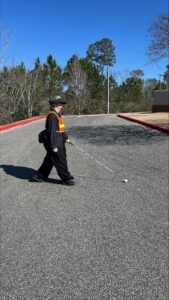
Photo description: In a black outfit, safety vest and hat, Heidi crosses a driveway while using her long white cane. The clear, blue sky dominates the background of the photo.
Day 2
I’m in Dothan for Heidi, who has been visually impaired for quite a long time, but is not a long-time resident of Dothan. She moved to the southeastern part of the country from the northwest part, Idaho, to care for her aging father a few years back, but has only lived in Dothan a short time.
Mark Twain said “It ain’t what you don’t know that gets you in trouble. It’s what you think you know for certain that just ain’t so.”
I realize soon after meeting with Heidi that my job this week is helping her correct the map in her head. She wants to go to Publix (oh the horror), her credit union and a few restaurants that are all within walking distance for her, but her mental map is off. She’s tried to follow that map a couple times and gotten really confused. Never truly lost, but things didn’t work out at all like she planned.
We start our first lesson just trying to figure out how to get off campus of her apartment building. There’s an intersection of sidewalks that we eventually name “Five Points” was really confusing to her. We get that figured out and then the fun really begins.
After crossing an intersection at a light, it’s a ton of curb travel and evil, evil parking lots. “Curb travel” meaning there are no sidewalks and the cane user will use the curb, or whatever is at the edge of the road, to ensure they aren’t walking in the middle of the street.
On top of all that, we can’t even walk on the left side of the street the whole time during our curb travel. Pedestrian safety laws decree that pedestrians should be on a sidewalk, if available, and on the left side of the street if not. This is not just for pedestrians who are blind, it’s for anyone walking in the street. Being on the left side puts you closer to the oncoming traffic, but also allows them to see you, and your cane, sooner and give you more space.
The route to Publix is fraught with peril, mostly from the evil, evil parking lot, but also from there not being a curb on our left the whole time, and the numerous driveways she has to cross to get to the sidewalk. This is not for the faint of heart, nor for a beginning cane user. Luckily for me, Heidi is neither. She received training in Idaho years ago and has maintained her skills. She’s also not afraid of close traffic. That’s a good thing, because all of her current travel goals reside in this and the adjacent shopping center NOT designed for pedestrians.
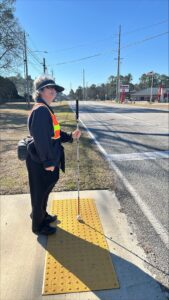
Photo description: Dressed in black with a yellow safety vest, Heidi stands on yellow truncated domes holding a long white cane while waiting for the light to change.
Day 3
I need to lower my expectations of hotel breakfasts. I just get disappointed by their version of what eggs are supposed to look and taste like, and don’t get me started on what they call “bacon.” My Publix supplies pull me through every time.
Heidi and I start our day with another run to Publix and the other restaurants to which she wants to travel. She’s got the main points on her map plotted out pretty well, and we’re now filling in the details with all the shops in between. There’s lots of landmarks and clues that she picks up on, and some I point out. For instance, Five Guys is the only shop on our route that plays music outside. The ramp at the end of the crosswalk from the parking lot to the sidewalk leads directly to the poké place (poké, pronounced “po-kay”, is basically sushi in a bowl, for those uncultured louts who may be reading this. Ha!) All these details are filling in the map AND expanding Heidi’s general knowledge of her environment. She has no plans to ever eat poké, but it helps her to know where the building that sells it is.
After lunch, which for me was a ribeye sandwich at a combo butcher shop called the Salty Sammich, Heidi and I begin to learn a new route to the credit union. Through the same evil, evil parking lot, but in a different direction. We skirt the outside of the parking lot (sometimes on the correct side of the street, some not), cross a lot of driveways, and then we have to cross the parking lot of the credit union, another evil, evil place.
At this point, I got to teach Heidi a cane skill. Three-point touch is a technique that has… wait for it… three points to it. See how clever that is? Anyway, Heidi, while using the cane to follow the curb, must sweep the cane in front of her to make sure her next steps are clear, but also needs to use her cane to locate a sidewalk on top of the curb.
- Touch away from the curb.
- Touch the curb.
- Touch on top of the curb.
- Repeat as you walk forward until you locate the intended sidewalk.
Having located it, she located the front door, located the tellers in the back and got some cash. She knows how to do things. All she needed was a tiny piece of information to get her there.
Successfully making it back to the apartment building, Heidi asked if we could walk over to the hospital next door to make sure she could independently find the clinic for her appointment in the morning. Orientation and mobility (O&M) is everything, and everything is O&M. She knows the hospital very well, but the clinic location is a fairly new one, so now her map is expanded even more.
Dinner tonight was from Jim & Nicks, an Alabama chain. I had the pulled pork with some really tangy BBQ sauce to compliment it. It needed no sauce, as it was done right, but the sauce was really good. The baked beans were maybe better than the pork, and the coleslaw was nice and crisp.
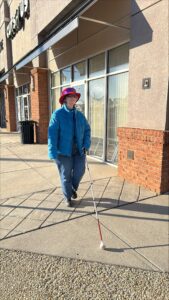
Photo description: Wearing a blue coat, jeans and a great, red hat, Heidi uses her long white cane on one of the few sidewalks on which we got to travel all week.
Day 4
We worked both routes today, but did the route to the credit union first, then the Publix route. Regulars in the parking lot are getting used to seeing us out there, which is a good thing. Having people expecting to see you is WAY better than surprising them. Same thing with crossing the street at the lighted intersection. Having drivers expecting to see Heidi on the corner getting ready to cross is a good thing.
Now, not everyone is going to yield to her, nor should they all. Traffic that can turn in front of her without getting too close should go ahead and do so, mostly because it’s so much easier to understand what’s happening in the intersection if everyone behaves normally.
If you’re a driver and you’re reading this, please pay attention here. If you see a person on the street that’s using a cane or a guide dog to travel, please just drive like you normally would. If you do something different just because you see a blind traveler, the blind traveler will know something different is happening, but not know why. If they’re out there, they have the skills to be safe out there, so you just keep doing what you would normally do, and let them make decisions on when to cross the street. And for pity’s sake, PLEASE DO NOT HONK! There’s no way for a person who is blind to know what that honk means. Does it mean “go” or “stop”? Are you even honking at me? There’s no way to verify that. Just drive, folks, and let the person who is blind make their decisions.
In between routes, I had breakfast for lunch. Ray’s is a local diner that serves breakfast all day. There were real eggs, crispy bacon and cheese grits done to perfection. Ray’s also is the home of the Table of Knowledge, a table or two set aside for the early morning crowd to discuss and hopefully fix the goings on in the world. I’m sorry to say that I never made it to the Table of Knowledge, but I DID make it to the world’s smallest city block.
Dothan is known for being in the heart of the wiregrass, its downtown murals, and for the world’s smallest city block. It’s right behind the civic center in downtown Dothan at the intersection of Appletree, College and Museum Streets. Yes, the world’s smallest city block is, in fact, not a block, but a triangle, but a block nonetheless. The Guinness Book of World Records certified it as such.
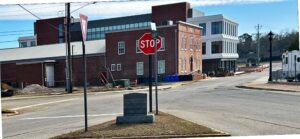
Photo description: The world’s smallest city block is triangular-shaped and not much bigger than my kitchen table. On it stands a marble marker and various street signs.
Day 5
We put it all together today. The credit union and Publix, and even a new route to the ATM at the credit union. Right in the middle of the evil, evil parking lot. And just when I thought I might get out of Friday easily, Heidi asked for a new route.
People ask me a lot about ATMs and why the ones at the drive through have braille on them. Well, its for folks just like Heidi, who walk through the drive-through. She can now get to the ATM safely and do her own business. Also, a lot of people get driven through the drive-through and sit on the driver’s side in the back seat. Same deal, they can do their own business.
There’s a Little Caesar’s on the list of places that Heidi has wanted to travel, and we’ve walked past it all week. Today, she stopped and got herself a pizza to enjoy when we were done. She also stopped at Publix yesterday for some groceries. She’s just living her life. That’s one of the things that’s so great about this job. I get to be a small part of being adjacent to people getting their independence back. Very groovy.
Day 6
Back at the Dothan airport this morning, I had to take off my shoes at security for the first time since I got my TSA precheck. Don’t know why, but I don’t care. Totally worth it if it keeps us all safe.
After re-shodding myself, I spoke with a civil service contractor whose job it was to ensure that our military bases around the world had the most up-to-date Air Traffic Control (ATC) systems around, and that everyone involved knows how to use them. He was on his way to an airbase in Germany. He told me that the ATC systems at the JFK airport in New York were somewhere between 40 and 60 years old! Doesn’t exactly nurture a sense of confidence in safe flights.
If JFK airport’s system is that old, how’s everyone else doing? My main concern is for the systems at Atlanta and Houston, but I’ll be headed somewhere else soon. If you read another blog post, you’ll know they got it right again.
Written by Barry Staford, certified orientation and mobility specialist (COMS)