


If your dog has had a soft tissue strain, TPLO surgery, or other injury, you may be wondering how best to support them between vet or rehab appointments. Or, if your furry friend is getting older, you may be looking for ways to aid their mobility aside from their regular joint supplements.
PEMF (pulsed electromagnetic field) dog beds and other therapy devices can be a helpful way to promote healing in injured, postsurgical, and aging dogs. PEMF benefits are wide-ranging in our furry friends and can be used in a variety of situations.
What is PEMF?
“PEMF therapy devices produce microcurrents which stimulate the release of nitric oxide,” says Dr. Courtney Wheeler, PT, CCRT, a canine physical therapist at Walking Paws Rehab in Boulder, CO. “When nitric oxide is released in the body, it helps to reduce inflammation and enhances vasodilation (blood flow), increases bone healing like after a TPLO, enhances muscle function, and helps promote angiogenesis (formation of new blood vessels).”
Dr. Wheeler recommends PEMF dog beds, mats, or other devices for “orthopedic, degenerative, and neurologic issues, as well as swelling and surgical pain.” She says that PEMF has also been proven to assist in wound healing and for dogs with stress/anxiety.
PEMF devices are particularly good for soft tissue injuries, muscle recovery for active dogs who compete in agility, flyball, dock diving, and other high-impact sports, and for dogs who could use anti-stress support around triggers like thunderstorms, fireworks, or travel.
Talk with your vet or canine physical therapist before using PEMF for your dog, as there are some contraindications (such as pacemakers, Holter monitors, insulin pumps, and hemangiosarcomas) that PEMF devices should not be used with.
Traits We Want in the Best PEMF Products for Dogs
Settings: Ideally, a PEMF device should have multiple settings or frequencies that are best suited to different uses. Some frequencies are best used for rapid healing, while others are better for stress relief. Generally, the frequencies are measured in Hertz (Hz) and treatment settings sit between 3 and 60 Hz.
Ease of use and price: The easier a product is to use, the more likely you’ll be to use it. We like PEMF devices that are simple to turn on and change the settings. The larger PEMF dog mats and PEMF dog beds are generally easier to use than a device you need to place or hold on your dog but can also be more expensive. If you’re on a budget, smaller devices may be a better option.
Design: The design of the dog PEMF device you choose should be best suited to your specific dog. For example, if you have a calm, well-trained dog who will sit still for a 15-minute treatment, a device that you place on or over them can be useful. If your dog isn’t comfortable being handled to that extent, a PEMF mat or bed may be a better option as it allows your dog to opt in and opt out of treatment.
Best PEMF Mat for Dogs: Petspemf Pad
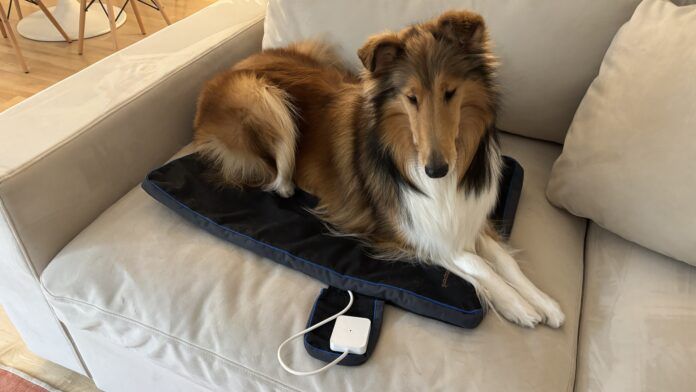
When my dog had an agility injury, our Canine Physical Therapist recommended that I get a PEMF dog bed and told me that the Petspemf Pad was the most budget-friendly option on the market. I’ve used this pad regularly for my Collie’s iliopsoas strain, but I also love to use it to keep my dogs calm and keep their muscles loose while traveling or after hectic, busy days.
This pad features four different settings with different PEMF frequencies: Pain Relief (50.6 Hz), Accelerated Healing (15.2 Hz), Stress Relief (4 Hz), and Integrated Healing (15.2 Hz).
The pad connects to a companion app that can be a bit buggy—it sometimes takes a few tries to connect to the app. However, you only need to use the app to change the settings. If you’re using the same setting every session, you simply need to double tap the battery box on the pad, and it’ll turn on without the app.
The app allows you to select treatment times between 30 minutes and up to 8 hours. The battery life on this pad is stellar, and it regularly lasts 12+ hours on a single charge. My dogs really gravitate toward this pad when I put it on top of the beds they already like, and the lightweight design is easy to move around and travel with.
Best PEMF Bed for Dogs: HigherDOSE Infrared PEMF Pet Bed
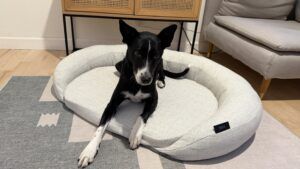
Like the HigherDOSE PEMF mat for humans, the brand’s HigherDOSE Infrared PEMF Pet Bed offers a wide range of PEMF therapy frequencies and settings plus the added bonus of infrared heat. The combo of heat and PEMF frequencies work together to help support your dog’s recovery from sore muscles, long stressful days, or acute or chronic injuries.
I love that this bed comes with six different frequency settings and two different heat settings. The instruction manual lays out which setting is best for each use case:
- Level 1: Sleep and recovery
- Level 2: Stress Relief and balance
- Level 3: Relaxation and circulation
- Level 4: Recovery and strength
- Level 5: Mobility and rejuvenation
- Level 6: Energy and performance
All of the treatment settings sit between 3 to 60 Hz.
This bed needs to be plugged into a power outlet during use and is fairly heavy, so it’s an at-home only option that’s not well suited to travel. The plush bolster gives your dog a place to rest their head or snuggle into, but the main bed section isn’t plush or squishy, so dogs who like plush beds may not gravitate towards this option. This bed comes in two sizes (large and small), and sports a minimal, aesthetically pleasing design.
Best Non-Ned PEMF Device for Dogs: Assisi LOOP
If budget is on your mind or if your dog is experiencing a sudden issue, the Assisi LOOP is a great option to try out PEMF for the first time at a relatively reasonable price. This works well for surgical recovery or “one time” injuries.
This isn’t a forever product—the LOOP works for about 150 15-minute treatments. The battery has a limited life and works best when you allow 2 hours of resting time in between treatments. You may be able to get more than 150 treatments out of the device when following this protocol. The battery doesn’t need to be recharged, but it will die eventually and the entire device will need to be replaced.
While other options on this list are pads or dog beds, the LOOP is a wearable device. It can be worn around your dog’s neck, placed on a leg, or simply set on top of the dog. Depending on the location of your dog’s injury or pain, you may need to manage them or hold the device so it stays on top of them. The LOOP has a treatment range of 10 inches, so as long as it remains within 10 inches of the area you want to treat, your dog will receive the benefits.
Other Dog PEMF Products
Though we didn’t test these options personally, here are additional high-rated PEMF devices on the market:
Assisi Loop Lounge
The Assisi Loop Lounge is Assisi’s PEMF bed option and is one of the only options on the market that offers a thicker, plush dog bed as opposed to a thin mat. This bed comes in three sizes and starts at $949 for the smallest size. This bed will last for 6,000 treatments before it needs to be replaced.
If the Petspemf large bed is too small for your dog, the Respond Bio-Pulse PEMF Dog Bed Therapy System is another option for frequent travel or crate use which comes in larger sizes than the Petpemf. It’s more expensive than the Petspemf pad, but cheaper than the Assisi Loop Lounge. This option is more of a mat/pad than a true padded bed, but it’s moderate price and larger size is attractive to many pet parents. This is a favorite of many dog sport enthusiasts and vet physical therapists.
This PEMF mat offers three different frequency settings (5, 10 and 15Hz), a rechargeable battery, and a 30-minute treatment time with auto shut off feature.
