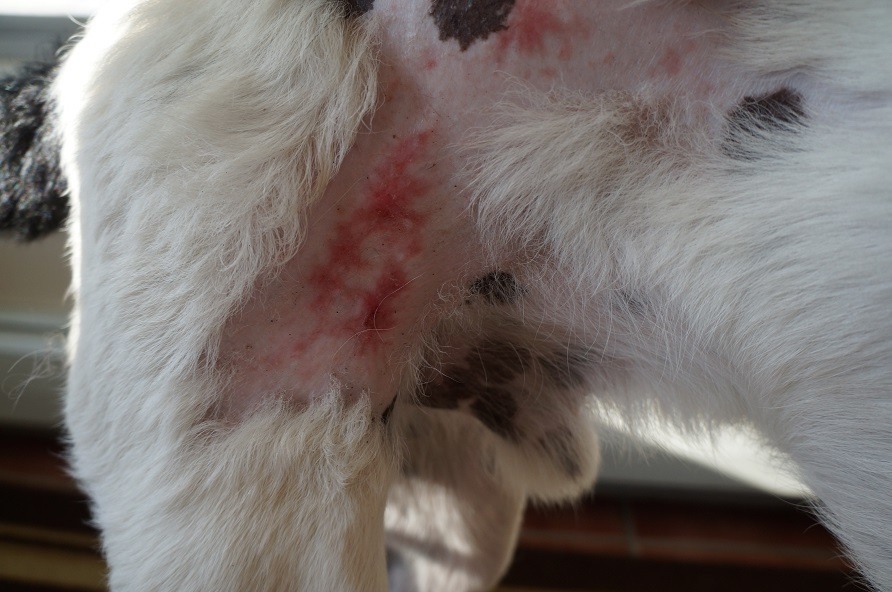




To be honest, things aren’t going great with Mr. Stix’s massive dermatology problems. It feels like nonstop failure, but that’s just how things like this are. We can keep the worst of it a bit at bay, but we’re never going to fix it for real. That’s partly because throwing everything at it could ultimately shorten his life — which isn’t an option for something that’s awful, but not deadly itself. I try to adjust my expectations and not fixate on it because it’s never going to completely heal, but things got really bad due to an infection a while back. And, now, after many, many weeks of antibiotics, his skin still looks bad. We’re trying to avoid using steroids, even short term. I felt like I got sloppy with some of his doses of supplements for dogs with skin issues, so I had to do a little math and dug into this veterinary paper called “Evidence for Nutraceuticals to Treat Dermatologic Disease in Dogs.” I debated including photos of how bad his skin looks, way at the bottom of this post. Scroll at your own risk.
Do Supplements for Dogs With Skin Issues Work?
The short answer is kind of yes, in some cases, but the scientific evidence isn’t as robust as anyone would prefer. The paper looked at several types of supplements for dogs with skin issues and their effect on things like allergic dermatitis, autoimmune diseases (immune system attacks the body’s own healthy cells), and immune-mediated diseases (other immune responses that can cause inflammation).
So, it’s much harder to say that anything that might work on one type of dog dermatology issue will also work on another. It’s all very specific, with many moving parts of treatment options and disease mechanisms. You really need to rely on your veterinary dermatologist for these decisions.
Basically the researchers reviewed prior studies, ranked them for the “strength of evidence” on a scale of 1 to 5, with 1 being the strongest evidence from double-blinded, placebo-controlled studies and 5 being more like case reports.
Here are the supplements they considered:
- Essential fatty acids (EFAs) – usually from fish oil
- Niacinamide – a form of Vitamin B
- Palmitolylethanoamide (PEA) – another fatty acid
- Probiotics
- Retinoids
- Vitamin A
- Vitamin D
- Vitamin E
- Zinc
I’m really boiling things down here — mostly as they apply to our Mr. Stix since essential fatty acids (fish oil) do have some evidence behind them. He also takes Vitamin E, as recommended by our veterinary dermatologist. All our dogs also take daily probiotics, but that’s more of a general health thing.
It’s important to know that these supplements were evaluated in addition to standard treatment and NOT ALONE as the only treatment. Also, the quality of dog supplements, and supplements in general, is varied, so that makes knowing if they work harder.

Study Conclusions
“Minor evidence for the beneficial use of several nutraceuticals, including essential fatty acids, niacinamide and probiotics, was found for treatment of specific cDIMIDs. These nutraceuticals may improve clinical signs or reduce the required dose of concurrent medication (e.g. drug-sparing effect) in some dogs. Some nutraceuticals also may be used for long-term maintenance therapy. Despite some promising findings, major evidence for the use of nutraceuticals in cDIMIDs is lacking, warranting further research.”
That Brings Us to Mr. Stix’s Fish Oil Dose
Nobody quite knows the best dose of eidosapentaenoic acid (EPA) and docosahexaenoic acid (DHA) fatty acids, but some suggest 125 mg (combined EPA and DHA) for every 1 kg of body weight. Note, that it s a lot higher than what our own veterinary dermatologist recommends. That would be 2,375 mg per day for Mr. Stix (around 19 kg).
I asked our veterinary dermatology team to tell me the right dose again for Mr. Stix, and they replied as follows: “For fish oil, Stix’s daily dose of EPA combined with DHA is 1000 mg. Every fish oil supplement is different, so please check the label for EPA and DHA, then give accordingly. Splitting the dose will reduce the risk of GI upset.”
In case you didn’t know, too much fish oil can cause diarrhea in dogs.
So, I looked at the label on the kind of pricey liquid fish oil our veterinary dermatologist recommends and tried to do some math, which is always hilarious for a word person like me. [I have no relationship with the fish oil company. Just sharing because it’s what we personally use.]

The label says that there’s 736 mg EPA and 460 mg DHA in 1 teaspoon. So, that’s 1,196 in a teaspoon, which is about 20% more than the 1,000 our veterinary dermatologist wants me to give Mr. Stix each day.
I used an online conversion calculator to find out that 1 teaspoon is about 4.9 ml. And, then 80% of that is 3.9 ml as a daily dose — let’s just call it 4 ml per day total, which means 2 ml each with breakfast and dinner.
The good news is that I’ve been less sloppy with my fish oil doses than I thought. I have been giving about that much twice a day (not super carefully measuring with a syringe, though). I will try to be better.

So How Bad Is It?
For reference, I’m including what his permanent nakey spot (from unknown puppyhood trauma) looks like when it’s perfect (from 2019). I included several photos from over the years, including one from yesterday.
Everyday after breakfast, he takes 3 oral meds (1 OTC and 2 Rx), and I apply 2 topical Rx meds to the sores. I do my best to keep it clean and to keep him from licking. I make him wear a no-lick collar for many hours after applying the topical meds. Our poor buddy man. The problem only affects his permanent nakey spot (exposed / scar). It does not show up anywhere else, so if he had not been injured so badly, including 15 fractures before being rescued, he probably would not have these skin problems. To borrow a phrase from Heather Cox Richardson (from after Alex Pretti’s murder in MN), I’m furious beyond articulation at whoever injured Stix as a puppy and left him alone in the wintertime mountain wilderness (for an estimated 6 weeks until he was seen and rescued on the side of the canyon road).